Main menu

  • About
    • Leadership
    • Our Team
    • Vision, Mission and Values
    • Health and Economic Impact
    • Strategic Plan
    • News and Stories
    • Careers
  • Research
    • Research Focus
      • Brain Health
      • Cancer
      • Digital Health
      • Healthy Aging and Mobility
      • Heart Health
      • Immune System
      • Injury and Rehabilitation
      • Lung Health
      • Mental Health and Substance Use
      • Other Research Focus Areas
    • Research Centres and Programs
      • BC Centre on Substance Use
      • Centre for Aging SMART
      • Centre for Clinical Epidemiology and Evaluation
      • Centre for Lung Health
      • Dilawri Cardiovascular Institute
      • Djavad Mowafaghian Centre for Brain Health
      • International Collaboration On Repair Discoveries
      • M. H. Mohseni Institute of Urologic Sciences
      • Ovarian Cancer Research Centre
      • Community Research Program
      • Emergency Medicine Research Program
      • Hematology Research Program
      • Skin Research Program
    • Research Cores
      • Clinical Trials Platform
      • VCH-VCHRI AI Hub
      • Indigenous Health Research Unit
    • Researcher Directory
    • Events and Workshops
    • Participate in Research
  • Research Services
    • New to VCHRI
      • Working at VCHRI
      • Regulations and Training
      • Membership with VCHRI
    • Research Development
      • Awards and Funding
      • Research Facilitation
      • Grant Management
      • Learning and Development
    • Contracts and Compliance
      • Contract Facilitation at VCHRI
      • Operational Approval
      • Research Privacy
      • Clinical Trials Administration
    • Research Support
      • Communications and Media Relations
      • Financial Policies and Procedures
      • VCH-VCHRI AI Hub
    • Internal Awards
    • Clinical Research
    • Indigenous Research
  • Clinical Trials
    • Clinical Trials Platform
      • Phase 1 Clinical Trials Research Unit
      • Hematology Research Unit
      • Clinical Research Unit
    • Find a Study
    • Researcher Directory
  • Participate in Research
    • Reasons to Participate
    • Participant Stories
    • Find a Study
    • Recruitment Support

User menu

  • Log in

Breadcrumb

  1. Home
  2. Research
  3. Participate in Research
  4. When snoring goes from personal quirk to public health concern

When snoring goes from personal quirk to public health concern

Stories Apr 20, 2020 3 minutes

Study shows link between obstructive sleep apnea and occupational injury in BC.

The connection between snoring and risks to public health and safety may not come to mind immediately, but Vancouver Coastal Health Research Institute scientist Dr. Najib Ayas’s research looking at some of the consequences of obstructive sleep apnea (OSA)—the most common type of snoring—illustrate how one person’s poor sleep can be harmful to others.

“I don’t think we take sleep apnea seriously enough,” says Ayas, associate professor in the Department of Medicine at the University of British Columbia (UBC). “Research has shown an association between OSA and safety in terms of motor vehicle crashes and occupational injuries.”

“With occupational injuries, sometimes it’s not just the injured person who is affected by an incident but other people can be injured as well. There are financial consequences to these types of incidents that can impact others too.”

Dr. Najib Ayas is an associate professor in the UBC Department of Medicine and a staff member at the Leon Judah Blackmore Centre for Sleep Disorders at UBC Hospital.

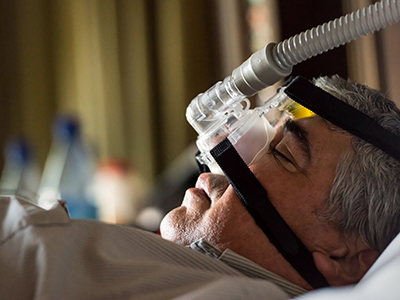
OSA occurs when the throat closes during sleep and is characterised by recurrent asphyxia, choking or gasping for air, and loud snoring. People with OSA experience tiredness during the day and feel as though their sleep is not refreshing. The scale used to measure OSA categorizes the condition according to the number of times that an individual experiences events like  choking or gasping for air, in one hour of sleep. A moderate to severe case of OSA involves more than 15 events per hour of sleep, while a severe case is classified by more than 30 events per hour.

In a recent paper, featured in the publication Lung, Ayas and co-authors Drs. AJ Hirsch Allen and Bernardo Peres used provincial data to determine whether individuals with OSA are at increased risk of occupational injury. The researchers looked at individuals who sought a medical assessment for suspected OSA at the UBC Sleep Laboratory between 2003 and 2011, and then linked their data to information from Worker’s Compensation Board claims to see if any of them had experienced occupational injuries. The study found that individuals with more severe sleep apnea tended to have a higher rate of occupational injuries.

Ayas hopes that this information can be used to increase awareness about OSA and workplace injury risks. 

“The assumption is that if you can identify individuals with OSA, then you can hopefully mitigate some of those risks with treatment and education.”
Some industries are starting to pay more attention to the importance of quality sleep in terms of trying to manage fatigue on the job, which is encouraging, adds Ayas. 

“I believe that sleep apnea needs to be incorporated into fatigue risk models that are used, for example, in the airline industry to ensure that pilots are sufficiently rested and alert enough to fly.”

Research fills gap about global health burden of obstructive sleep apnea

Using global data from epidemiological studies, Ayas also took part in the first research effort of its kind to find a more accurate number of how many people worldwide have OSA.

Published in The Lancet: Respiratory Medicine, the study reported that an estimated 936 million middle-aged adults aged 30-69 years have at least mild OSA and 425 million have moderate to severe OSA globally; this includes approximately 1,000,000 adults in Canada. China, followed by the USA, Brazil, and India showed the highest number of individuals with OSA. The majority of these patients have not been clinically diagnosed. 

“Our findings tell us about the potential health burden of OSA,” says Ayas. “It allows us to more closely know the number of people who need treatment or diagnosis and highlights the enormous scope of this global problem given that untreated OSA is associated with myriad adverse health outcomes including cardiovascular disease.”

 

Researchers

Najib Ayas

Related Articles

Ask an expert: How can I tell if I have sleep apnea?

New solution to treat obstructive sleep apnea

Ask an expert: How does fatigue affect my ability to drive?

Share:

  • Facebook
  • Linkedin
  • Twitter
  • Instagram
  • Email

Related Research Centres/Programs

Centre for Lung Health

Get the latest research headlines in your inbox

Subscribe

Recent News and Stories

Type
Stories

Ask an expert: How can I strike a healthier balance with my daily habits?

Sep 10, 2026 exercise, mobility
Type
Stories

Moving endometrial cancer prevention upstream

Sep 8, 2026 women, cancer, uterine
Type
Stories

Improving respiratory protection for wildland firefighters

Sep 3, 2026 lung, environment, safety
See more news

Get updates!

Join our newsletter mailing list to stay up to date on features and releases.

Subscribe

Quick Links

  • News and Stories
  • Careers
  • Events
  • Media Enquiries

Follow Us

  • LinkedIn
  • Instagram
  • Bluesky
  • YouTube

© 2026 VCHRI. All rights reserved.

  • Contact
  • Privacy Policy