Main menu

  • About
    • Leadership
    • Our Team
    • Vision, Mission and Values
    • Health and Economic Impact
    • Strategic Plan
    • News and Stories
    • Careers
  • Research
    • Research Focus
      • Brain Health
      • Cancer
      • Digital Health
      • Healthy Aging and Mobility
      • Heart Health
      • Immune System
      • Injury and Rehabilitation
      • Lung Health
      • Mental Health and Substance Use
      • Other Research Focus Areas
    • Research Centres and Programs
      • BC Centre on Substance Use
      • Centre for Aging SMART
      • Centre for Clinical Epidemiology and Evaluation
      • Centre for Lung Health
      • Dilawri Cardiovascular Institute
      • Djavad Mowafaghian Centre for Brain Health
      • International Collaboration On Repair Discoveries
      • M. H. Mohseni Institute of Urologic Sciences
      • Ovarian Cancer Research Centre
      • Community Research Program
      • Emergency Medicine Research Program
      • Hematology Research Program
      • Skin Research Program
    • Research Cores
      • Clinical Trials Platform
      • VCH-VCHRI AI Hub
      • Indigenous Health Research Unit
    • Researcher Directory
    • Events and Workshops
    • Participate in Research
  • Research Services
    • New to VCHRI
      • Working at VCHRI
      • Regulations and Training
      • Membership with VCHRI
    • Research Development
      • Awards and Funding
      • Research Facilitation
      • Grant Management
      • Learning and Development
    • Contracts and Compliance
      • Contract Facilitation at VCHRI
      • Operational Approval
      • Research Privacy
      • Clinical Trials Administration
    • Research Support
      • Communications and Media Relations
      • Financial Policies and Procedures
      • VCH-VCHRI AI Hub
    • Internal Awards
    • Clinical Research
    • Indigenous Research
  • Clinical Trials
    • Clinical Trials Platform
      • Phase 1 Clinical Trials Research Unit
      • Hematology Research Unit
      • Clinical Research Unit
    • Find a Study
    • Researcher Directory
  • Participate in Research
    • Reasons to Participate
    • Participant Stories
    • Find a Study
    • Recruitment Support

User menu

  • Log in

Breadcrumb

  1. Home
  2. Research
  3. Participate in Research
  4. Changing the narrative on mental health care

Changing the narrative on mental health care

Stories Apr 5, 2022 3 minutes

Investigating a collaborative and innovative approach to health and wellness using peer expertise.

Mental illness increases the risk of substance use, disability and premature death. Since the start of the COVID-19 pandemic, more Canadians reported experiencing mental health issues — such as depression, anxiety and post-traumatic stress disorder — jumping from one in five Canadians in 2020 to one in four in 2021. 

These are among the reasons why researchers Drs. Regina Casey, Simon Davis, John Higenbottam and a team of peer experts and students are investigating the local feasibility of the Recovery College (RC) model. The model encourages people in need of mental health care to take charge of their recovery by providing access to resources and supports for developing greater awareness of their individual recovery needs and for setting and attaining well-being goals.
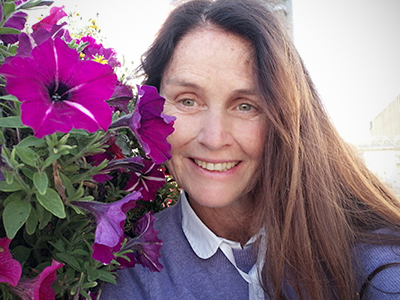
Dr. Regina Casey is a clinical associate professor in the Department of Occupational Science and Occupational Therapy at the University of British Columbia, and an instructor and psychosocial rehabilitation program coordinator in the Department of Psychology/Social Science at Douglas College.

“The RC model does not focus on medical diagnosis and treatment, but rather on empowering community members to learn and also share their expertise through co-producing and leading courses with content of interest to the community,” explains Casey. “The model helps students develop what we call a ‘preferred narrative’, or their own take on their personal experiences, and hone mental health self-management and other important skills for pursuing self-determined life goals.”

A 2020 study that surveyed the RC landscape found widespread participant satisfaction and evidence for the model’s effectiveness in supporting recovery in community settings. However, it also noted gaps in research that could, if addressed, improve the program’s overall effectiveness. 

“Accumulating evidence suggests that involvement in co-creating course content or participating in workshops on mental health self-management have boosted self-esteem, hope and knowledge of recovery.”

Essential to RC fidelity is the notion of co-production with peers, which involves co-design of the course, co-delivery of course content by peer facilitators and co-execution of the course evaluation.
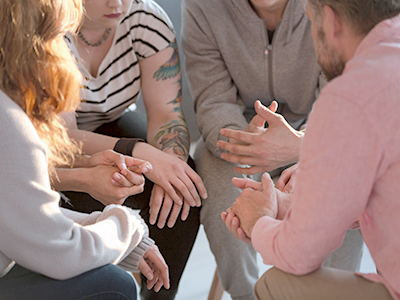
Co-production emerges in what the Canadian Mental Health Association (CMHA) describes as “innovative learning spaces where anyone can access free courses, webinars, workshops and events to learn, gain new skills and connect with others in their community,” says Casey. 

“This preventative and collaborative approach fundamentally differs from a typical system approach in which people who face mental health challenges are treated through more reactive and formal programs or institutions,” she adds. 

A collaborative approach tailored to individual- and community-level needs

For her research, Casey’s team is evaluating the process of co-production for the pilot RC courses. The first pilot course, Sleep, Exercise, Environment and Support, was co-produced and co-facilitated by two peer navigators from CMHA Vancouver-Fraser and CMHA North and West Vancouver. Participants learned to apply a framework for building positive self-care practices over five weekly sessions. 

The second pilot course, Coping with Uncertainty, followed a curriculum of strategies for building resilience during uncertain times. It was offered twice and co-produced and co-facilitated by Vancouver Coastal Health Peer Educators. Participants in these weekly sessions received a workbook for review and reflection that covers several tools explored in the course.

“We anticipate realizing positive outcomes in all courses during the virtual pilot program that can be further developed into a sustainable in-person Recovery College centre within three to five years.”

“Peers are the drivers in the RC model,” Casey explains. “Their expertise, along with key study findings, will contribute to the long-term co-design, co-creation, co-delivery, co-production and co-evaluation of the program.” 

Related Articles

On-hand support while awaiting eating disorder care

Reducing crash risk among people with schizophrenia

Ask an expert: What are some signs that gambling is starting to affect my brain health?

Share:

  • Facebook
  • Linkedin
  • Twitter
  • Instagram
  • Email

Related Research Centres/Programs

Community Research Program

Get the latest research headlines in your inbox

Subscribe

Recent News and Stories

Type
Stories

Ask an expert: How can I strike a healthier balance with my daily habits?

Sep 10, 2026 exercise, mobility
Type
Stories

Moving endometrial cancer prevention upstream

Sep 8, 2026 women, cancer, uterine
Type
Stories

Improving respiratory protection for wildland firefighters

Sep 3, 2026 lung, environment, safety
See more news

Get updates!

Join our newsletter mailing list to stay up to date on features and releases.

Subscribe

Quick Links

  • News and Stories
  • Careers
  • Events
  • Media Enquiries

Follow Us

  • LinkedIn
  • Instagram
  • Bluesky
  • YouTube

© 2026 VCHRI. All rights reserved.

  • Contact
  • Privacy Policy