From improving cancer diagnostic accuracy to enhancing treatment effectiveness, AIM Lab applies innovative technologies to transform health care delivery.
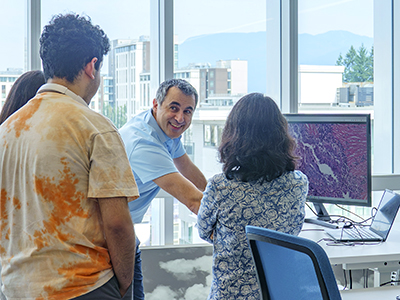
When you step into the Artificial Intelligence in Medicine Lab (AIM Lab), the energy is hard to miss. Located at the University of British Columbia (UBC), AIM Lab stands apart from traditional laboratories. Instead of glassware and Petri dishes, it is powered by advanced computer systems designed to tackle some of medicine’s most complex challenges.
Led by Vancouver Coastal Health Research Institute investigator Dr. Ali Bashashati, AIM Lab pushes the boundaries of patient care by applying artificial intelligence (AI) to cancer diagnostics and treatment planning.
“Bringing together researchers, engineers and health care professionals, our multidisciplinary team develops cutting-edge solutions to some of the most urgent challenges in medicine.”

At the heart of cancer diagnosis is histopathology — the microscopic examination of stained tissue slides. While it is critical for guiding treatment, the process can be slow and subjective. Differences in sample preparation, staining techniques and human interpretation all affect results, sometimes leading to delays or disagreements in diagnosis.
AIM Lab is tackling these challenges by developing AI models capable of scanning and analyzing large datasets in real time. These tools aim to reduce diagnostic variability, speed up turnaround times and enable pathologists to focus more on complex decision-making.
International AI competition for ovarian cancer diagnosis
Ovarian cancer is the most lethal gynecologic cancer, with only a 44 per cent five-year net survival rate in Canada. Accurate diagnosis depends on pathologists identifying one of five common tumor subtypes. However, access to highly specialized gynecological pathologists is limited, especially outside major urban areas, and even experts may sometimes disagree on interpretations.
To bridge this gap, AIM Lab launched an international AI brain challenge in 2024 — the UBC Ovarian Cancer Subtype Classification and Outlier Detection (UBC-OCEAN). This crowdsourced competition invited developers worldwide to design models capable of distinguishing ovarian cancer subtypes. Participants trained their algorithms on the world's most extensive ovarian cancer histopathology dataset, with images contributed from over 20 medical centers.
UBC-OCEAN quickly became the world’s largest histopathology AI competition, with more than 1,700 participants and 35,000 model submissions. Now, AIM Lab is preparing to evaluate the top-performing models and pilot the winner across British Columbia. This phase will test real-time performance and examine how pathologists interact with AI tools in their workflow.

Exploring prostate cancer biomarkers through machine learning
Another active project at AIM Lab focuses on prostate cancer, developed in partnership with the M.H. Mohseni Institute of Urologic Sciences and the Vancouver Prostate Centre (VPC). The goal is to distinguish between patients with low-risk prostate cancer — who can be safely monitored — and those with high-risk cancer requiring early treatment.
Most prostate cancer patients fall into the low-risk category. However, existing biomarkers are limited in predicting who might eventually develop aggressive disease. AIM Lab’s AI model addresses this by identifying subtle tissue patterns that help more accurately assess patient risk.
To test the model’s accuracy, it was validated on two independent cohorts: one from VPC and another from a consortium study between Fred Hutchinson Cancer Center and UBC.

“The AI model helped reveal tissue patterns that differentiate low- from high-risk patients,” says Bashashati. “It proved that AI can support cancer grading and inform treatment decisions.”
Looking forward, AIM Lab plans to enhance the model by integrating genomic data, combining tissue and genetics to further improve prediction accuracy.
“What excites me most are the discoveries we make,” says Bashashati. “We identify challenges in the clinic and then explore how AI can help solve them. We strive not just to build models, but to implement them — and make a real difference in patients’ lives.”
Learn more about research studies underway at AIM Lab, which is affiliated with the Department of Pathology and Laboratory Medicine, the Department of Urologic Sciences and School of Biomedical Engineering at UBC.
"Behind the Lab Doors” is a Research Insider series that offers a behind-the-scenes glimpse into the labs of health researchers across VCHRI. These stories explore research currently in the works, including ongoing and long-term studies that have the potential to directly impact the quality of patient care and clinical conditions. To see your VCHRI-affiliated lab featured in an upcoming article, contact us at vchricommunications@vch.ca.