Main menu

  • About
    • Leadership
    • Our Team
    • Vision, Mission and Values
    • Health and Economic Impact
    • Strategic Plan
    • News and Stories
    • Careers
  • Research
    • Research Focus
      • Brain Health
      • Cancer
      • Digital Health
      • Healthy Aging and Mobility
      • Heart Health
      • Immune System
      • Injury and Rehabilitation
      • Lung Health
      • Mental Health and Substance Use
      • Other Research Focus Areas
    • Research Centres and Programs
      • BC Centre on Substance Use
      • Centre for Aging SMART
      • Centre for Clinical Epidemiology and Evaluation
      • Centre for Lung Health
      • Dilawri Cardiovascular Institute
      • Djavad Mowafaghian Centre for Brain Health
      • International Collaboration On Repair Discoveries
      • M. H. Mohseni Institute of Urologic Sciences
      • Ovarian Cancer Research Centre
      • Community Research Program
      • Emergency Medicine Research Program
      • Hematology Research Program
      • Skin Research Program
    • Research Cores
      • Clinical Trials Platform
      • VCH-VCHRI AI Hub
      • Indigenous Health Research Unit
    • Researcher Directory
    • Events and Workshops
    • Participate in Research
  • Research Services
    • New to VCHRI
      • Working at VCHRI
      • Regulations and Training
      • Membership with VCHRI
    • Research Development
      • Awards and Funding
      • Research Facilitation
      • Grant Management
      • Learning and Development
    • Contracts and Compliance
      • Contract Facilitation at VCHRI
      • Operational Approval
      • Research Privacy
      • Clinical Trials Administration
    • Research Support
      • Communications and Media Relations
      • Financial Policies and Procedures
      • VCH-VCHRI AI Hub
    • Internal Awards
    • Clinical Research
    • Indigenous Research
  • Clinical Trials
    • Clinical Trials Platform
      • Phase 1 Clinical Trials Research Unit
      • Hematology Research Unit
      • Clinical Research Unit
    • Find a Study
    • Researcher Directory
  • Participate in Research
    • Reasons to Participate
    • Participant Stories
    • Find a Study
    • Recruitment Support

User menu

  • Log in

Breadcrumb

  1. Home
  2. Research
  3. Participate in Research
  4. Discovering the likely cause of manic symptoms in bipolar disorders

Discovering the likely cause of manic symptoms in bipolar disorders

Stories Mar 31, 2023 3 minutes

Researchers have found a link between the reduced activity of a mood-regulating neurotransmitter in the brain and bipolar mania.

In a breakthrough study, researchers have identified a potential root cause of acute manic symptoms among people with bipolar disorder. Characterized by periods of extreme highs followed by long-lasting depression, bipolar disorder can have harmful effects on patients and their loved ones. 

The new study, led by Vancouver Coastal Health Research Institute researcher Dr. Lakshmi Yatham, is the first to discover a relationship between manic symptoms experienced by people with bipolar and a decrease in dopamine transporter density.

Dr. Lakshmi Yatham is a member of the Djavad Mowafaghian Centre for Brain Health, and a professor and head of the Department of Psychiatry and director of the Institute of Mental Health at the University of British Columbia.

The dopamine transporter protein is responsible for the flow of dopamine from neurons, also known as nerve cells, into the synaptic space between neurons. The released dopamine transmits signals through dopamine receptors between these neurons. 

The dopamine neurotransmitter is a hormone that supports certain motor functions in humans, as well as emotions and executive functions, such as learning, memory, mood and cognition. 
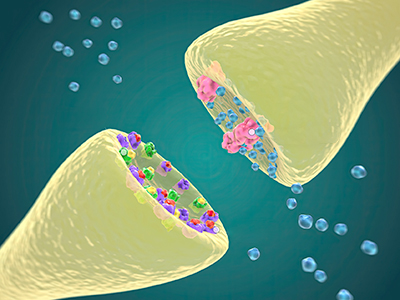
An overabundance or lack of dopamine can lead to neuropsychiatric conditions, such as mania, depression and Parkinson’s disease.

In bipolar disorder, excess dopamine has been linked to manic episodes, which can lead to feelings of euphoria, anger, irritability, extreme happiness or aggression. These may also lead to sleep loss, engagement in risky behaviours and an inability to focus or pay attention. 

“Most currently used treatments for mania reduce the function of dopamine D2 receptors,” says Yatham. “These medicines can cause a number of side effects, such as tremor, rigidity, elevation of lipids, development of diabetes and weight gain.”

“The goal is to develop bipolar treatments that specifically target the core abnormality and improve symptoms rapidly without causing significant side effects.”

Discovery opens the door to new treatments for bipolar patients with mania 

Published in JAMAPsychiatry, Yatham’s study compared the brain scans of 27 people with bipolar disorder against those of healthy controls without bipolar disorder. 

Study participants received a positron emission tomography (PET) scan, which uses a radioactive isotope to illuminate cells and their receptors in the body, and a magnetic resonance imaging (MRI) scan, which uses powerful magnets and radiofrequency waves to create three-dimensional images of tissues and bones.

The scans of bipolar patients with acute mania showed a reduction in dopamine transporter density. This reduction in transporter density occurred in the striatum — a centrally located region of the brain responsible for such behaviours as emotions, rewards, motivations and motor activity. 

“Our study showed that manic patients had lower densities of the dopamine transporter, which correlated with the severity of manic symptoms.” 

Reduced dopamine transporter density is expected to cause an excess of dopamine in the synaptic space that can lead to increased dopamine signaling and manic symptoms.

Scans of the 17 study participants with recently resolved mania and healthy controls showed relatively normal dopamine transporter density. In comparison, the scans of bipolar patients with mania had a 45 per cent reduction in dopamine transporter density on the right side of their brains and a 42 per cent reduction on the left side versus healthy participants.
 
Compared to bipolar patients with remitted mania, acute mania bipolar patients had a 40 per cent reduction in dopamine transporter density on the right side of their brains and a 37 per cent reduction on the left. 

“Assuming that an abnormality in the dopamine transporter is indeed a key driver of mania among bipolar patients, this opens up completely new possibilities for treatment.”

There is no current treatment that specifically targets the dopamine transporters to increase the uptake of dopamine from synaptic space into the pre-synaptic nerve cells. 

“The challenge now is to develop a new medication that increases the reuptake of dopamine through the dopamine transporter with an excellent safety and tolerability profile,” says Yatham.


 

Researchers

Lakshmi Yatham

Related Articles

The influence of social situations on memory

Rethinking head impacts across contact sports

Behind the lab doors: Investigating blood biomarkers as a window into brain health at Wellington Laboratory

Share:

  • Facebook
  • Linkedin
  • Twitter
  • Instagram
  • Email

Related Research Centres/Programs

Djavad Mowafaghian Centre for Brain Health

Get the latest research headlines in your inbox

Subscribe

Recent News and Stories

Type
Stories

Ask an expert: How can I strike a healthier balance with my daily habits?

Sep 10, 2026 exercise, mobility
Type
Stories

Moving endometrial cancer prevention upstream

Sep 8, 2026 women, cancer, uterine
Type
Stories

Improving respiratory protection for wildland firefighters

Sep 3, 2026 lung, environment, safety
See more news

Get updates!

Join our newsletter mailing list to stay up to date on features and releases.

Subscribe

Quick Links

  • News and Stories
  • Careers
  • Events
  • Media Enquiries

Follow Us

  • LinkedIn
  • Instagram
  • Bluesky
  • YouTube

© 2026 VCHRI. All rights reserved.

  • Contact
  • Privacy Policy