Main menu

  • About
    • Leadership
    • Our Team
    • Vision, Mission and Values
    • Health and Economic Impact
    • Strategic Plan
    • News and Stories
    • Careers
  • Research
    • Research Focus
      • Brain Health
      • Cancer
      • Digital Health
      • Healthy Aging and Mobility
      • Heart Health
      • Immune System
      • Injury and Rehabilitation
      • Lung Health
      • Mental Health and Substance Use
      • Other Research Focus Areas
    • Research Centres and Programs
      • BC Centre on Substance Use
      • Centre for Aging SMART
      • Centre for Clinical Epidemiology and Evaluation
      • Centre for Lung Health
      • Dilawri Cardiovascular Institute
      • Djavad Mowafaghian Centre for Brain Health
      • International Collaboration On Repair Discoveries
      • M. H. Mohseni Institute of Urologic Sciences
      • Ovarian Cancer Research Centre
      • Community Research Program
      • Emergency Medicine Research Program
      • Hematology Research Program
      • Skin Research Program
    • Research Cores
      • Clinical Trials Platform
      • VCH-VCHRI AI Hub
      • Indigenous Health Research Unit
    • Researcher Directory
    • Events and Workshops
    • Participate in Research
  • Research Services
    • New to VCHRI
      • Working at VCHRI
      • Regulations and Training
      • Membership with VCHRI
    • Research Development
      • Awards and Funding
      • Research Facilitation
      • Grant Management
      • Learning and Development
    • Contracts and Compliance
      • Contract Facilitation at VCHRI
      • Operational Approval
      • Research Privacy
      • Clinical Trials Administration
    • Research Support
      • Communications and Media Relations
      • Financial Policies and Procedures
      • VCH-VCHRI AI Hub
    • Internal Awards
    • Clinical Research
    • Indigenous Research
  • Clinical Trials
    • Clinical Trials Platform
      • Phase 1 Clinical Trials Research Unit
      • Hematology Research Unit
      • Clinical Research Unit
    • Find a Study
    • Researcher Directory
  • Participate in Research
    • Reasons to Participate
    • Participant Stories
    • Find a Study
    • Recruitment Support

User menu

  • Log in

Breadcrumb

  1. Home
  2. Research
  3. Participate in Research
  4. Aerobic exercise is as good for the older adult brain as it is for the body

Aerobic exercise is as good for the older adult brain as it is for the body

News Releases Jul 23, 2015 3 minutes

News Release

Aerobic exercise may be a very promising strategy to reduce older adults’ risk of cognitive decline due to silent mini-strokes.

Vancouver, B.C., July 23, 2015 – Break out the sweatbands and the oldies – 60 minutes of good old-fashioned aerobic exercise may be more potent than any pill to reduce older adults’ risk of cognitive decline due to silent mini-strokes, according to new research by Vancouver Coastal Health Research Institute scientist Dr. Teresa Liu-Ambrose.

Cerebrovascular disease is the second most common cause of dementia in older adults, behind Alzheimer’s disease. Research suggests that reducing heart health risk factors, such as high blood pressure, may reduce dementia risk, and possibly even slow down the progression of cognitive decline caused by mini-strokes, also known as vascular cognitive impairment or VCI. Population studies suggest that silent mini-strokes are common, even among middle-aged adults.

“This made us believe that aerobic exercise, such as running and brisk walking, may be a very promising strategy against vascular cognitive impairment,” says Dr. Liu-Ambrose, Canada Research Chair, Physical Activity, Mobility, and Cognitive Neuroscience at the University of British Columbia and researcher at the Djavad Mowafaghian Centre for Brain Health. “Past research shows that aerobic exercise not only decreases heart health risk factors but may also improve brain structure and function. Yet, to date, no intervention studies have specifically examined the usefulness of aerobic training in reducing the progression of VCI due to mini-strokes.”

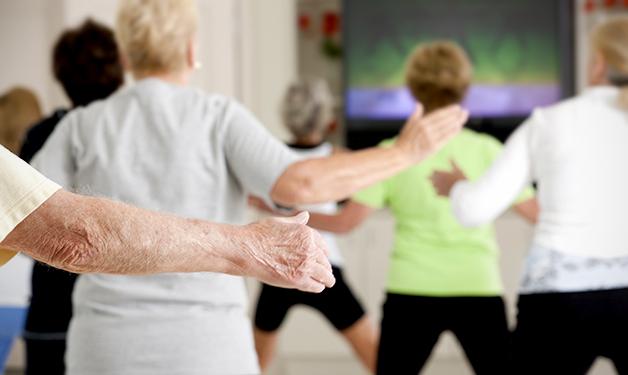
At the Alzheimer’s Association International Conference 2015, Dr. Liu-Ambrose and colleagues will present findings from a six-month study of 71 adults aged 56 to 96 with confirmed cases of mild VCI. Participants were assigned to two groups: one that did supervised aerobic exercise three times per week for 60 minutes with certified fitness instructors, and the other that received standard care plus an education seminar on nutrition once per month. All completed a memory and thinking test at the beginning and end of the study. Sixty-two of the 71 participants completed the full six-month study.

The researchers found that study participants who took the aerobics classes improved their cognitive function significantly, including memory and selective attention, compared to the participants who received standard care. In addition, functional brain scans acquired before and after the six-month study showed that the brains of study participants became more efficient with aerobic exercise training. Aerobic training also significantly reduced body mass index and increased functional capacity.

The study builds on findings by Dr. Liu-Ambrose in 2010 and 2012 that resistance training in particular can reverse cognitive decline in older women. In 2014, research by Dr. Liu-Ambrose also found that aerobic training twice per week, and with gradual progression, led to significant increases to the brain’s hippocampal volume, essentially reversing the pattern of cognitive decline commonly seen with aging and dementia.

“While these new and promising results need to be replicated in larger and more diverse populations, the fact that aerobic exercise can improve cognitive function in VCI means that people with the condition can hope there may soon be a proven tool they can use to prolong their independence and improve their quality of life,” said Dr. Liu-Ambrose. “We think this is exciting because exercise is a strategy that can be inexpensively delivered at the population level.”


 

Researchers

Teresa Liu-Ambrose

Related Articles

Helping people with bipolar disorder see their cognitive strengths

Keeping your head in the race: Cognitive impacts observed among ultra-marathon runners

Cognitive abilities play a key role in fall prevention among older adults

Share:

  • Facebook
  • Linkedin
  • Twitter
  • Instagram
  • Email

Related Research Centres/Programs

Djavad Mowafaghian Centre for Brain Health

Get the latest research headlines in your inbox

Subscribe

Recent News and Stories

Type
Stories

Ask an expert: How can I strike a healthier balance with my daily habits?

Sep 10, 2026 exercise, mobility
Type
Stories

Moving endometrial cancer prevention upstream

Sep 8, 2026 women, cancer, uterine
Type
Stories

Improving respiratory protection for wildland firefighters

Sep 3, 2026 lung, environment, safety
See more news

Get updates!

Join our newsletter mailing list to stay up to date on features and releases.

Subscribe

Quick Links

  • News and Stories
  • Careers
  • Events
  • Media Enquiries

Follow Us

  • LinkedIn
  • Instagram
  • Bluesky
  • YouTube

© 2026 VCHRI. All rights reserved.

  • Contact
  • Privacy Policy