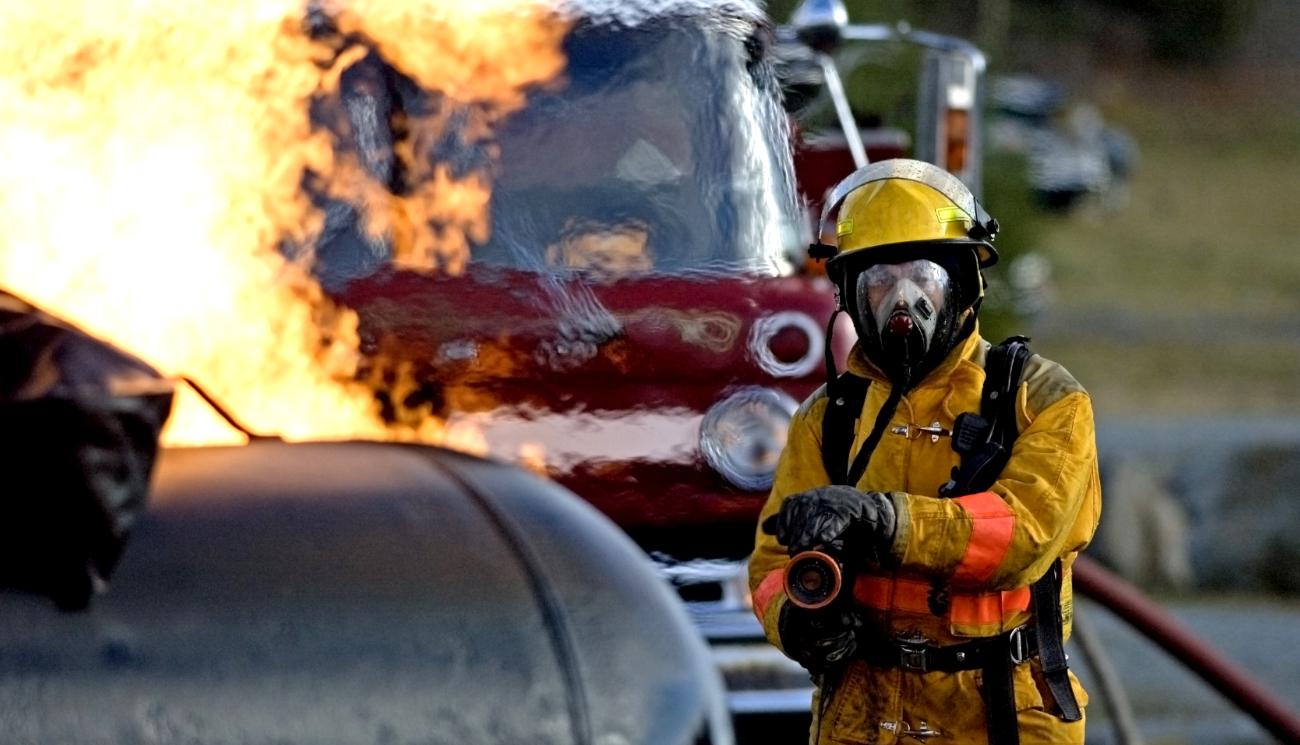
A first-of-its-kind study identifies compounds captured by respirators used to fight wildfires, highlighting the need for more wearable protection.
Wildland firefighters are frequently exposed to harmful compounds found in wildfire smoke, making the use of respirators for airway protection particularly important. However, there are no mandatory requirements for wildland firefighters to wear respirators and many have expressed concerns surrounding the comfort, breathability and restricted communication of respirators while performing their physically challenging duties in hot, unstable and often steep terrain.

Vancouver Coastal Health Research Institute researcher Dr. Renelle Myers recognized that improving respiratory protection for wildland firefighters requires more information about how current respirators perform. Her research is the first real-world study to examine and document the many particles trapped in respirators used in active wildfires.
“Prior to our study, the majority of data on filters was from laboratory or simulation studies,” says Myers. “It is hard to reproduce in a lab setting wildfire smoke exposures that are occurring while on the job, performing a variety of different duties.”
"This study helped us see what types of substances are found in these wildfires that are, in many ways, burning in our own backyards.”
Wildfires release a complex mixture of pollutants into the air as they burn forest debris and other infrastructure found in wilderness, rural or remote areas. Among these pollutants is particulate matter, which can be carried many kilometres on prevailing winds.
Particulate matter smaller than 10 microns (PM10) or less than 2.5 microns (PM2.5) in diameter is a significant health concern. Both PM10 and PM2.5 exposure can irritate lung tissues, exacerbating preexisting conditions, such as cardiac and respiratory disease, as well as asthma, emphysema and chronic obstructive pulmonary disease (COPD). Exposures to these particles are also associated with lung cancer.
Respirator cartridges capture a range of hazardous compounds
Myers and her team tested four types of replaceable respirator filter cartridges worn by 19 wildland firefighters in active wildfire operations across B.C. The cartridges tested were seven black D80921-series, 10 pink 60926-series and one each of the D80926-model and 60925-model.
Inside each cartridge was a layer of glass fibre paper, microfibre glass or synthetic filter media, as well as a layer of activated carbon or charcoal. The former was better at capturing larger particles and the latter at capturing chemical gasses, says Myers.
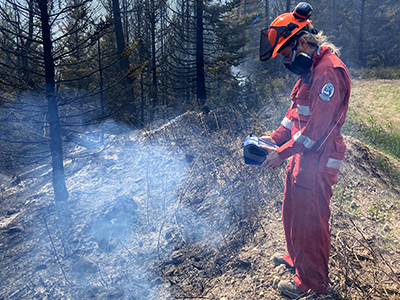
Researchers used thermal desorption-gas chromatography-mass spectrometry — a relatively quick and highly sensitive technique for chemical identification at the molecular level — to identify compounds trapped in the cartridges.
In total, the research team detected 496 wildfire smoke compounds captured by the respirators. Of the compounds detected, 24 were listed on publicly available databases as carcinogens or endocrine disruptors, which impact hormones in the body.
“Our findings demonstrate the importance of respiratory protection for both gas and particle pollutants.”
“Our study identified many carcinogens — including Group 1 carcinogens, such as benzene — captured in the filters,” states Myers. “Chemical compounds classified as Group 1 carcinogens have been described in the scientific literature as having links to cancer.”
Myers and her team also identified several Group 2B compounds, which are possibly carcinogenic to humans, along with Group 3 compounds that require more information to determine whether they are carcinogenic.
“A big question for future investigation is: how can wildland firefighters know when to change their filters?”
Almost 55 per cent of the compounds identified in the cartridges’ paper or microfiber filter layers were oxygenated aromatics, which can react with other compounds to contribute to the formation of PM2.5 and/or ground-level ozone.
Thirty-six per cent of all compounds captured in the activated carbon layer were aromatic hydrocarbons, another class of compound frequently found to be carcinogenic. Additionally, polycyclic aromatic hydrocarbons — known carcinogens — were captured on both the paper or microfibre filters and activated carbon layers.
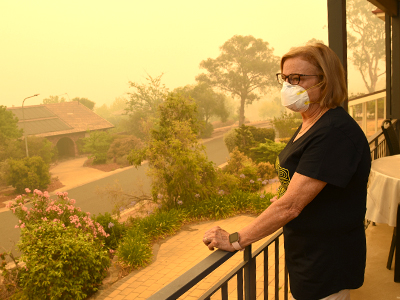
Given the important role of respirators in filtering out toxic compounds, Myers hopes that her findings will inform upgrades to respirator design to improve their comfort and appeal to wildland firefighters, encouraging more to wear respirators when dousing blazes.
“Something that warrants emphasis is that respirators work,” says Myers. “Now we need to identify a design that balances functionality with wearability.”
“A respirator that is 80 per cent effective but worn 100 per cent of the time is way better than one that is 100 per cent effective but worn 10 per cent of the time.”