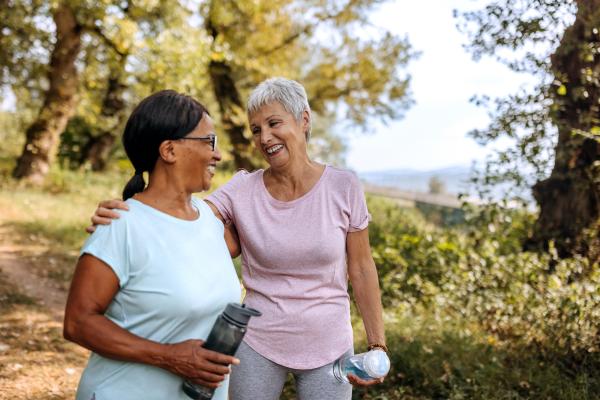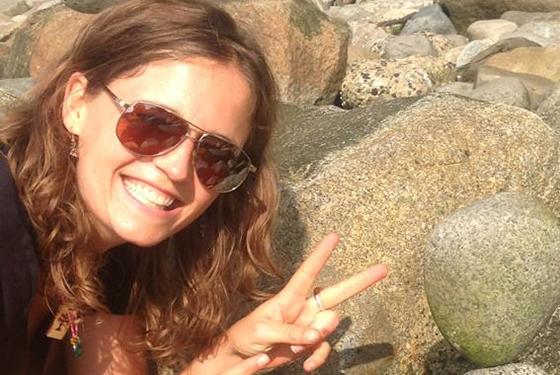
Get to know Anna and her goal of understanding what neighbourhood features support healthy aging.
Anna Chudyk is a third year doctoral candidate in the Experimental Medicine program at UBC; she is working under the supervision of Dr. Heather McKay at the Centre for Hip Health and Mobility. Anna holds an Honours Bachelor’s degree in Health Sciences and a Masters in Epidemiology and Biostatistics, both from the University of Western Ontario. Anna’s thesis research includes an examination of the built environment (human-made infrastructure that comprises our towns and cities), travel behaviour, and physical activity – and how these factors can influence healthy aging. She is the recipient of a Vanier Canada Graduate Scholarship awarded by the Canadian Institutes of Health Research.
What is your area of interest? And what led you to this?
I am interested in healthy aging and environments that support healthy aging. I was very close to my grandparents growing up. This closeness inspired me to volunteer with older adults in nursing homes, at hospitals, and in the community – during which time I witnessed the power of physical activity and social connections in the maintenance of health and recovery from illness in old age. Moving from “small town” Ontario to “big city” Vancouver heightened my awareness of the important influence of the design of urban spaces on people’s opportunities to be physically active and to interact socially with others. The contrast between my new and old homes, coupled with my established interest in supporting healthy aging, guided me to my current area of study. I want to know how the built environment enables (or prevents) older adults to remain active, healthy, and engaged in their communities for as long as possible. Older adults are a population who are particularly susceptible to the design of their neighbourhoods. For example, for an older adult living in a sub-division kind of neighbourhood where it is not easy to walk places, the loss of a drivers’ license might prevent him/her from getting out to their local community centre for programming that supports physical activity and social opportunities – and from there physical activity can decline and he/she becomes at risk of social isolation.
What has been the proudest moment in your career?
I’d probably say the final day of data collection for “Walk the Talk” (my doctoral study). So much hard work went into the plan, design, and conduct of the study. The moment I realized that “we did it” was surreal. I am so grateful to have worked with and learned from community partners (especially BC Housing and the City of Vancouver), our participants, my mentors, and our amazing research team at the Centre for Hip Health and Mobility.
If you could be any superhero, which would you be and why?
I think I’d be a combination of superheroes from the “Ninja Turtle” superhero family. Splinter was wise, April brought in the “girl power” and the Ninja Turtles all had skills that complemented each other. I’d be capable of tackling anything!
If you could invite any three people (living or dead) to dinner, who would they be and why?
My dinner party attendees would be Jane Jacobs, Tommy Douglas, and Lao Tzu.
Jane Jacobs was a grassroots activist and a writer. She pioneered the concept of “healthy cities” as dense, mixed-use, walkable communities that promote the development of strong social networks. I’m sure that I could pick her brain about how to interpret some of my thesis data!
Tommy Douglas was instrumental in the establishment of Canada’s universal healthcare system and devoted his life to standing up against injustice. I think he would inspire me and teach me about the art of rallying people in the name of common causes.
Lao Tzu was an ancient Chinese philosopher whose work has a tremendous influence on how I approach and integrate my day-to-day experiences. His writings help me to become more aware of the ebbs and flows of life and to see the patterns and lessons around me.
Do you see yourself continuing the work and loving what you do in 20 years?
I certainly hope so! One of my mottos in life is, “we may not be able to change the world, but we can all make a dent.” I truly believe in the power of cities to promote the health and social connectedness of many people at once. And I believe that this research is a way for me to “make a dent” in the life of others.
What is your healthiest habit?
I try to meditate every day. It helps me to focus and alleviates stress. Meditation also gives me that extra “bounce in my step” where I’m more likely to see the glass as “half full” and events as “bumps on the road” rather than “defeats.” What’s the famous saying? “Be the change you want to see in the world.” It definitely helps me strive towards that.