Taking transit in downtown Vancouver has teens moving more.
Although it’s not the proverbial 10-mile hike in the snow uphill (both ways), getting to school as part of living in an urban environment gets teens more physically active than traveling to and from school in a suburban setting, according to a study out of the Centre for Hip Health and Mobility (CHHM), a Vancouver Coastal Health Research Institute centre.
“Active (non-motorized) transportation, such as walking or cycling, to school is a great opportunity for kids to engage in routine behaviour and obtain physical activity to meet the 60 minutes per day1 2 recommended for health benefits,” explains CHHM project manager and study lead author Amanda Frazer.

Published in Preventive Medicine Reports in February 2015, Frazer’s study “Differences in adolescents' physical activity from school-travel between urban and suburban neighbourhoods in Metro Vancouver, Canada” compared an urban sample of teenagers from Vancouver’s West End neighbourhood to a sample of teenagers from a suburban area of Surrey. The research team looked at how the youth traveled to school and how the various modes contributed to physical activity.
The study found that urban-dwelling teens walked to school more and got more physical activity from the school commute than their suburban-dwelling counterparts. Among those who walked to school, urban teens got 25% more physical activity. Urban walkers also had nearly three times more physical activity from their commute when compared to suburban passive travelers (i.e. car or bus users). Of particular interest though, was that urban students who used passive transportation to get to and from school accumulated the same amount of physical activity as the suburban students who walked to school. That is to say, even when using passive transportation, teens in the urban environment accumulated twice as much physical activity from school trips than suburban-dwelling teens using passive transportation. The authors believe this marked increase in passive transportation-related physical activity is to do with mode choice since the urban teens used public transit to get to school while most suburban teens were driven in the family car.
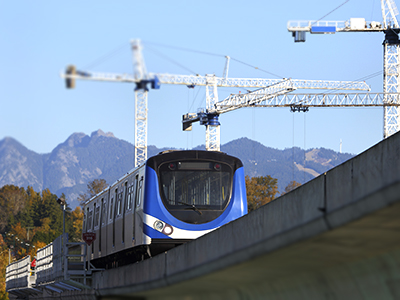
“Overall what we’ve found is that living in an urban setting may facilitate greater physical activity in adolescents during their trips to and from school,” says Frazer. “The West End is very unique, highly walkable, and connects to several transit lines, whereas the Surrey neighbourhoods had more typical suburban street networks – big broad arterials, fast moving traffic, and disconnected curvilinear streets, which creates a challenge for direct, safe routes to walk to school.”
Frazer’s message to parents: if teens have the opportunity to walk or cycle to school, they should take it. And for teens living farther from school, give public transit a try.
“We should be considering public transit an active mode of transportation since every public transit trip begins and ends with a walk.”
In suburbs, thoughtful city planning and design linking to public transportation help us to stay active
As suburbs throughout Canada continue to grow rapidly, there exist opportunities to design and plan them in a way that facilitates greater physical activity among residents.
“One of the things the study highlighted was the importance of public transit in enabling people to get physical activity during their travels,” says Dr. Megan Winters, CHHM investigator and assistant professor in the Faculty of Health Sciences at Simon Fraser University.

She adds that research such as Frazer’s, which has highlighted how the role and availability of public transport can bring the full complement of choices people have to get around, can be used by city planners, health practitioners, school boards, etc., when thinking about what they can do to help keep children and youth active and healthy.
“They’re looking at locally-based evidence that might support their policy decisions, actions they’re going to take, or programs they’re going to fund,” says Dr. Winters. “That’s where this research can play a role."
"Now we know that, for Metro Vancouver at least, travel by transit can really generate physical activity in similar ways to traveling by foot.”
1 WHO Global Strategy on Diet, Physical Activity and Health
2 Canadian Physical Activity Guidelines and Canadian Sedentary Behaviour Guidelines