
The hard-to-treat disorder comes with significant risks to patients, but has few treatments available to successfully halt symptoms.
A first-of-its-kind study for bipolar depression is an encouraging first step toward the discovery of an effective therapy for patients with the condition.
With support from Brain Canada, Vancouver Coastal Health Research Institute researcher Dr. Fidel Vila-Rodriguez compared the off-label use of magnetic seizure therapy (MST) and a Health Canada-approved type of electroconvulsive therapy (ECT) for bipolar depression. Researchers found that MST was virtually as effective at lowering depressive symptoms as right unilateral ultrabrief-pulse (RUL-UB) ECT — an approved treatment — but with fewer side effects and minimal post-treatment recovery time.

“MST significantly decreased symptoms of bipolar depression in 48 per cent compared to 50 per cent of individuals who received RUL-UB ECT,” says Vila-Rodriguez. “Given the severity of bipolar depression and its links to suicidality, this degree of reduction in depressive symptoms could be potentially life-saving for some patients.”
“This study puts front and centre that there may be a treatment option with fewer side effects for patients with a very severe condition.”
Bipolar disorder is characterized by intense highs and lows, with some patients experiencing manic episodes ranging from an extremely elevated mood to hallucinations and/or delusions. Other patients may experience a more subdued form of elevated mood called hypomania, which can lead to racing thoughts, restlessness, euphoria and irritability.
Depression accounts for around 75 per cent of the disorder’s concerning symptoms. Similar to major depressive disorder, bipolar depression can lower motivation and lead to persistent sadness, fatigue, lethargy and suicidality.
Maintaining treatment efficacy with reduced side effects
ECT is an established secondary option for treatment-resistant bipolar depression, following medication and other therapeutic interventions. However, the treatment, which uses electrical current to stimulate areas of the brain, might be associated with transient short-term memory and autobiographical memory loss — the loss of memories of specific personal events, such as what happened at a recent dinner with friends.
The RUL-UB ECT tested in Vila-Rodriguez’s study has a reduced risk of autobiographical memory loss, possibly because the electrical current used in the treatment targets a narrower region of the brain.
“We wanted to compare MST to the form of ECT associated with the least risk of cognitive side effects to provide a fair comparison between the two modalities,” Vila-Rodriguez explains.
Because MST directs electromagnetic induction energy — similar to that used to wirelessly charge a smartphone — to an even more focused region of the brain than RUL-UB ECT, researchers hoped it would provide significant therapeutic outcomes with fewer concerning side effects like autobiographical memory loss. This, they believed, could ultimately help lower barriers to treatment for some patients concerned about the cognitive risks of ECT.
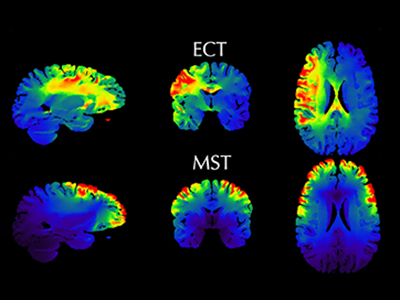
Image credit: Annika MacKenzie
The 55 adults with treatment-resistant bipolar depression who participated in the study were randomly assigned to either receive MST or RUL-UB ECT, with researchers and participants blinded to the selected treatment modality. Of these, 45 research participants completed at least eight MST or RUL-UB ECT sessions, up to 21, with a maximum of one treatment per day.
Results showed that remission of depressive symptoms was achieved among 20 per cent of participants in the MST group and 30 per cent in the RUL-UB ECT group. Most research participants did not experience clinically important worsening in autobiographical memory, specifically around 22 per cent of participants in the RUL-UB ECT group and approximately seven per cent in the MST group experienced this side effect.
Participants who received MST experienced a faster reorientation time, recovering from the treatment within 10 minutes compared with 20 minutes among patients who received RUL-UB ECT.
“Longer reorientation time is closely related to developing memory difficulties, such as autobiographical memory loss.”
“Faster recovery time is also associated with less time in the recovery room and earlier discharge,” explains Vila-Rodriguez. “This means that patients can get back to work or their daily activities sooner, making the overall treatment experience more palatable.”
With around half of MST and RUL-UB ECT patients showing at least a 50 per cent decrease in symptoms of depression, researchers believe that MST holds promise as an alternative therapy for treatment-resistant bipolar depression.
The research team is seeking opportunities to expand their research into MST for bipolar depression to more patients and, possibly, multiple sites. Additionally, Vila-Rodriguez and his team are in the midst of recruiting patients for another study testing the efficacy of MST to treat schizophrenia.
To inquire about participating in the ongoing Magnetic Seizure Therapy for Schizophrenia (MAST) Trial, contact 604-827-1361 or ninet.lab@ubc.ca.