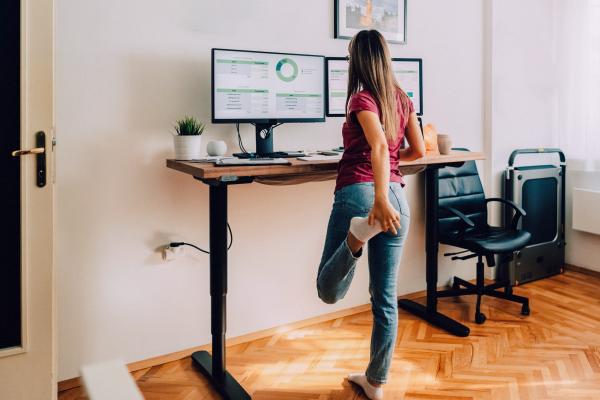
New national workplace activity program aims to boost employee health and productivity.
Office workers across Canada share a common problem—too much of their day is spent sitting at a desk. Sitting for long periods of time is associated with increased health risks, such as heart disease and obesity. Now, with input from Vancouver Coastal Health Research Institute scientist and kinesiologist Dr. Guy Faulkner, ParticipACTION Canada has launched a nation-wide workplace activity intervention to help people sit less and move more.
The UPnGO with ParticipACTION program was built on a pilot project developed by Faulkner that engaged more than 600 employees in nine companies across BC and Ontario. Using a self-monitoring app, employees were challenged to be more active during work hours and increase their daily step count. While the project was a success, Faulkner says the magic ingredient wasn’t the app technology—it was corporate culture.
“We saw the biggest gains when managers were fully on board with the program and when employees felt they had permission to sit less during the day without that being seen as dodging work," says Faulkner. "Like any intervention, it can only be as good as its implementation.”
“There’s more to improving workplace activity than just giving people an app to track their steps. The focus really needs to be on changing workplace culture.”
Faulkner’s feedback from analyzing management involvement has been incorporated into the national UPnGo program. The nine companies involved in the pilot study were all mid-size, without big human resources departments or workplace health strategies. Through the program, managers will be provided with more training and support for effective implementation. “One of the key aspects is modelling behaviour,” says Faulkner. “If a manager is seen to be actively taking part in the program themselves, it gives permission for workers to do so too.”
Faulkner says it is definitely worthwhile for employers to encourage employees to move around during the day. Research shows employees who are physically active are more productive and have less absenteeism.
“Extended bouts of sitting aren’t good for anyone. Even those who are physically active outside of work can lose some of the health benefits of being physically active after long periods of inactivity.” Faulkner says another important benefit of more activity throughout the day is the impact on presenteeism, which is when employees are at work, but they aren’t at their most productive. “If workers aren’t at 100 per cent, if they have low energy or poor ability to focus while at work, it affects overall productivity and morale.”
“Healthier employees are happier, and happier employees are healthier.”
Inspiring the inactive
While the six-week pilot project did result in modest overall gains of approximately 900 average daily steps, Faulkner says the biggest gains were with people who were less active to begin with. Individuals who did less than 6000 steps per day at baseline increased their daily average steps by approximately 3000. He says figuring out ways to get these employees on board with the voluntary UPnGO program should be a priority.
“The employees who are already fit and regularly active didn’t show huge gains. There are only so many steps you can add to a work day. But employees who previously weren’t very active at all experienced much bigger gains. We need to ensure those individuals are motivated to sign up. And generating that interest to participate can be linked back to an encouraging workplace culture.”
The new year-long UPnGO program now includes incentives, such as monthly rewards of items like water bottles, for employees who accumulate a target number of points on the app. Employees who want to do more sophisticated fitness tracking, can synch their app with trackers like FitBits and Garmins.
With statistics showing only 20 per cent of Canadians get the recommended amount of physical activity, the evidence-based UPnGo program could play an important role in improving national health. Organizations interested in bringing the UPnGO program to their office should contact participACTION to learn more. Individuals looking to track their activity can also access the free ParticipACTION activity tracking app.