Study to explore the relationship between aerobic exercise and chronic stroke.
We all know aerobic exercise is good our health, but for stroke patients, aerobic exercise may be a whole lot more: it may be the key that unlocks their brain’s ability to recover. Vancouver Coastal Health Research Institute scientist Dr. Lara Boyd is trying to figure out exactly now to make the key fit. Boyd and her team at the University of British Columbia have embarked on a study of exercise paired with motor learning patients with chronic stroke.
“We know that aerobic exercise wakes up the brain and primes it for learning in healthy populations,” says Dr. Boyd. This will be the first study pairing “priming” exercise and motor learning in people with chronic stroke.

Aerobic exercise has been shown to make the brain more ‘plastic’ or receptive to building long-term memory. But the trick is finding the perfect exercise “prescription” for effective stroke rehabilitation. What intensity of exercise? What duration? When to time the workout sessions? Dr. Boyd, who is also a researcher at the Djavad Mowafaghian Centre for Brain Health and the Canada Research Chair in Neurobiology of Motor Learning at UBC, hopes this study will provide some answers and help lead to a meaningful recovery for the thousands of Canadians who suffer disabilities from stroke.
"The stakes are so high. Although we’ve learned so much about the brain in the last decade we have failed to develop effective long-term recovery for brain injury. Stroke is the leading cause of long-term disability in this country. We need to find a better model for recovery."
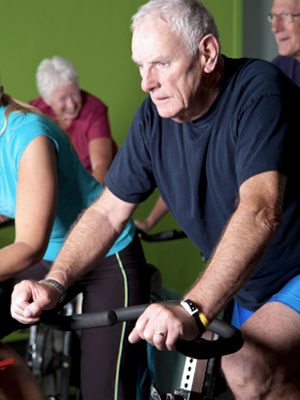
Long-term memory retention is essential for stroke recovery. “It’s no use to struggle to perform a motor-skill in a rehab session and create a short-term memory only to then have the brain forget it,” explains Dr. Boyd. “We have to crack the code for retention of learning for our patients.” She says long-term memory effects are only seen after 24 hours which is why her participants will be tested a day after their series of learning paired with aerobic exercise.
Building brain plasticity
The study will take a closer look at the exact mechanisms that link aerobic exercise to improved long-term memory. Researchers know that aerobic exercise promotes more blood circulation, which in turn bathes the brain in glucose and oxygen and excites neural inputs for learning. Exercise also promotes the production and release of a special protein called Brain Derived Neurotrophic Factor (BDNF) that repairs and builds the neural connections linked to long-term learning. Dr. Boyd and her colleagues will use MRI to see if any physical changes or neural growth take place in the brain, perhaps in areas that take over motor skill function from a damaged region.
"We know that we can change the brain. For these patients we have to figure out how," says Dr. Boyd.
Dr. Boyd got some unexpected help with this study: just as she began the funding application process an anonymous donor stepped forward with a gift of nearly $1 million. This out-of-the-blue donation meant she and her colleagues could get started right away. Dr. Boyd hopes that donor generosity will translate into a breakthrough for her patients.
But even if the study doesn’t produce the magic formula for motor-skill learning, Dr. Boyd is reassured that her study participants will still benefit.
"Exercise helps with mood, with energy, with heart health. Properly done, there is no downside. Our patients will feel better, be physically stronger, have better balance and may need less medication."
The study will continue for the next four years, with 60 participants.