
"I say yes to participate in research because it often leads to solutions and I want to be part of that."
– Jonathan MacDonald, St. John's, Newfoundland
The ability to communicate with the world through sign language from a young age gave Jonathan MacDonald a leg up from his older brother. Both children of a total four siblings were deaf; however, MacDonald was taught American Sign Language (ASL) after his parents saw the challenges MacDonald’s brother faced trying to learn and speak verbal English.
“By the time I was born, nine years after my brother, he still could not speak full sentences,” recalls MacDonald. “My parents decided that they wanted to try a different approach with me, so they put me in ASL lessons and learned ASL themselves.”
MacDonald continued to use and learn through ASL at the Newfoundland School for the Deaf and the Ernest C Drury School for the Deaf in Milton, Ontario. After high school, he enrolled at the Rochester Institute of Technology in New York to study environmental sciences and also received a Master of Science in Secondary Education of Students Who are Deaf or Hard of Hearing.
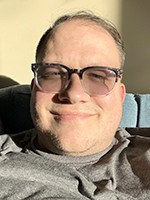
MacDonald, who identifies as culturally Deaf, admits that he was lucky to have largely been surrounded by people in the Deaf community and those who know ASL. Outside of these circles, communication can be several degrees less accessible.
“Many people do not know how to sign, despite there being around 357,000 culturally Deaf and 3.21 million hard of hearing Canadians,” notes MacDonald. This is also prevalent in the health care system, where the lack of ASL signers and interpreters can create barriers to care delivery that prevent those who are deaf or hard of hearing from accessing vital health information.
Improved pharmacy experiences for deaf, deaf-blind and hard of hearing individuals
Recently, MacDonald participated in a study led by Vancouver Coastal Health Research Institute researcher Timothy Lim. The study involved five, 1.5-hour focus groups with people who are deaf, deaf-blind or hard of hearing. With the help of interpreters, researchers asked participants questions about their experiences accessing pharmacy services.

Preliminary findings from the study identified trends in barriers to communication, such as assumptions that a person can hear clearly or speak English; a lack of a translator; or background noise making it more difficult to hear. Participants’ wish lists for pharmacy improvements included the expansion of accessible patient information on medications, such as through larger font sizes in written materials and the use of videos and interpreters.
“Our goal is to learn from community experiences so that we can improve patient education at the pharmacy.”
Improperly taken medication can lead to negative symptoms, as well as suboptimal disease control and treatment outcomes. Adverse drug events account for approximately 276,000 emergency department visits, 4,500 deaths and $100 million in health costs in B.C. each year. Patient information on how to take medication can help prevent these adverse drug events.
“One of the biggest challenges I have faced when at the pharmacy is that few pharmacists know ASL,” states MacDonald. “Even after I show them a written message to indicate that I am culturally Deaf, they often still try to speak to me verbally instead of using another approach.”
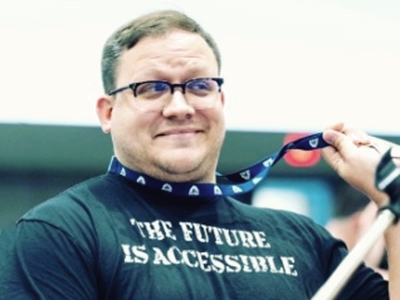
While queuing at a pharmacy to pick up medication, MacDonald has often wished for more accessible information and forms of communication. Visual cues, such as screens, or vibrating buzzers would be welcome features to alert patients when it is their turn in line, he notes.
Patients and the health care system as a whole stand to benefit when all patients are given accessible information about how to take their medication properly, says MacDonald. “Imagine how much more successful the health care system could be with small shifts in the delivery of care for people who are deaf or hard of hearing,” he adds, something many of us may experience at some point in our lives.
Learn more about this study and Vancouver Coastal Health services for deaf, deaf-blind and hard of hearing.
This is one patient's story of participating in a research study. Your experience may differ. Learn about clinical trials before participating.