Workshops raise health care providers’ awareness about weight bias.
Every day, we’re inundated with messages and images pressuring us to achieve impossible standards of physical beauty, the most important being a slim waistline. It’s not a surprise then that people living in larger bodies face weight bias. What is alarming is when that bias comes from their primary care physician.
“If you have a heavier person and a slimmer person present with the same knee pain, many times the heavier person will be advised to lose weight, while the slimmer person will be sent to physiotherapy,” says Gerry Kasten, a Vancouver Coastal Health Research Institute (VCHRI) scientist and registered public health dietitian. “So, people are being treated differently based on an aspect of their person.”

Kasten and his colleagues, Dr. Réka Gustafson, Megan Oakey, and Rani Wangsawidjaya, recently evaluated the incorporation of weight stigma messaging into physician-targeted presentations about a healthy eating resource adapted by Vancouver Coastal Health (VCH) called the Healthy Plate. The Healthy Plate concept uses images of meals on a plate to clearly illustrate what healthy eating looks like in every day life. The Healthy Plate messaging is simple, clear, and brief: optimally using a nine-inch plate, fill half of your plate with vegetables, then one-quarter with protein, and the other quarter with grains (which are preferably whole grains).
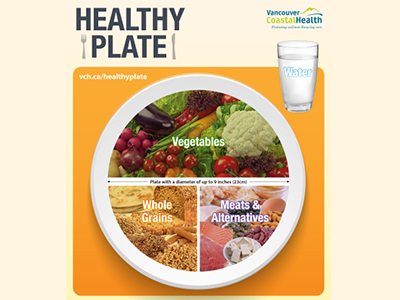
As part of a workshop and webinar presenting physicians and health care providers with information about the Healthy Plate and how to use it – as a resource for healthy eating rather than to encourage weight loss – the group shared information about the adverse health outcomes of asking patients to lose weight and evidence about the impact of weight stigma on health.
“Weight loss as a clinical goal actually carries harms with it – there’s possible disengagement from health care providers when people are told that they should lose weight. They actually become less physically active and may adopt maladaptive eating behaviours, or disordered eating,” says Kasten.
“Also, when you tell people to lose weight and they do, regaining that weight is common and it’s also likely that there may be more gain than the original loss.”
For their evaluation, the group collected qualitative and quantitative data from workshop and webinar participants to evaluate their response to the weight stigma information. Results from the study were presented at the 4th Annual Weight Stigma Conference held in Vancouver in April and their poster tied for the poster prize.
According to their findings, for the majority of participants, information about the possible negative consequences of weight-based advice was new. A few participants, however, felt that discussing healthy eating with their patients was not new and somewhat obvious – a response that VCHRI researcher and study co-investigator Dr. Réka Gustafson was glad to hear.
“That feedback is really important because this is where weight bias comes in – is looking at some of the harm we’ve done by trying to make it more complicated than being about the simplicity of healthy eating,” says Dr. Gustafson, a medical health officer for VCH.
Continuing education for physicians about healthy eating is essential
Dr. Gustafson admits that she didn’t receive much training about discussing healthy eating with patients when she attended medical school nearly 20 years ago.
“I think a lot of modern medical curricula has changed and new physicians have some training, but certainly I didn't,” she says. “One of the things I’d like to change is to make sure we provide continuing medical education to physicians about healthy eating.”
“I really want us to move away from saying things like, ‘You should lose some weight’, because that’s really tantamount to saying, ‘You shouldn’t get a heart attack’. That isn’t a change an individual can make in their daily life.”

“Physicians need to know that you can stand behind this information as advice because it has the same weight and has been assessed with the same rigour as a blood pressure medication, for example,” she explains. “You prescribe a blood pressure medication because the body of evidence indicates that that’s the first line treatment. And in terms of healthy eating, there are very basic but important trends emerging from the evidence about what leads to better health and other important trends emerging that tell us what does harm.”