
Main menu

  • About
    • Leadership
    • Our Team
    • Vision, Mission and Values
    • Health and Economic Impact
    • Strategic Plan
    • News and Stories
    • Careers
  • Research
    • Research Focus
      • Brain Health
      • Cancer
      • Digital Health and Artificial Intelligence
      • Healthy Aging and Mobility
      • Immune System
      • Injury and Rehabilitation
      • Lung Health
      • Mental Health and Substance Use
      • Other Research Focus Areas
    • Research Centres and Programs
      • BC Centre on Substance Use
      • Centre for Aging SMART
      • Centre for Clinical Epidemiology and Evaluation
      • Centre for Lung Health
      • Dilawri Cardiovascular Institute
      • Djavad Mowafaghian Centre for Brain Health
      • International Collaboration On Repair Discoveries
      • M. H. Mohseni Institute of Urologic Sciences
      • Ovarian Cancer Research Centre
      • Community Research Program
      • Emergency Medicine Research Program
      • Hematology Research Program
      • Skin Research Program
    • Research Cores
      • Clinical Trials Platform
      • VCH-VCHRI AI Hub
      • Indigenous Health Research Unit
    • Researcher Directory
    • Events and Workshops
    • Participate in Research
  • Research Services
    • New to VCHRI
      • Working at VCHRI
      • Regulations and Training
      • Membership with VCHRI
    • Research Development
      • Awards and Funding
      • Research Facilitation
      • Grant Management
      • Learning and Development
    • Contracts and Compliance
      • Contract Facilitation at VCHRI
      • Operational Approval
      • Research Privacy
      • Clinical Trials Administration
    • Research Support
      • Communications and Media Relations
      • Financial Policies and Procedures
      • VCH-VCHRI AI Hub
    • Find a Study
    • Indigenous Research
  • Clinical Trials
    • Clinical Trials Platform
      • Phase 1 Clinical Trials Research Unit
      • Hematology Research Unit
      • Clinical Research Unit
    • Find a Study
    • Researcher Directory
  • Participate in Research
    • Reasons to Participate
    • Participant Stories
    • Find a Study
    • Recruitment Support

User menu

  • Log in

Breadcrumb

  1. Home
  2. Research
  3. Participate in Research
  4. Mobile app helps track and manage symptoms of depression, anxiety

Mobile app helps track and manage symptoms of depression, anxiety

Stories Oct 3, 2014 2 minutes

Free resource intended for Canadian workers affected by clinical depression.

A new interactive app is helping Canadian workers with clinical depression better connect with their mental health care providers to track the status of their mental health and mood before, during, and after treatment. Depression is one of the leading causes of disability worldwide, especially in working-age adults. 

In Canada, as many as seven in ten people with clinical depression continue to work, despite struggling with their symptoms.

MoodFx (moodfx.ca) was designed as a helpful tool to assist people with depression and low mood overcome depression and feel better. The app and site assess a patient’s emotional well-being through responses to research-driven questions through a questionnaire that focuses on four areas of mental health: depression, anxiety, cognition, and work performance. Users can use MoodFx to screen for depression and anxiety problems to see whether they should seek help. Information is stored anonymously and securely.

“MoodFx is simple and easy to use, for both patients and doctors. It allows people to see how their symptoms improve over time and can alert their clinicians when they are not improving,” explains Vancouver Coastal Health Research Institute researcher Dr. Raymond W. Lam, Director of the Mood Disorders Centre and investigator at the Djavad Mowafaghian Centre for Brain Health. Dr. Lam created and led the development of MoodFx at the Mood Disorders Centre at UBC Hospital and the UBC eHealth Strategy Office. 

“MoodFx addresses a gap in depression treatment – the need for better screening and measurement-based care – by leveraging the ubiquity of mobile technology,” Dr. Lam adds. 

“Almost everyone has a smartphone, so why not use it to screen for depression and monitor treatment?” 

The web tool provides people in treatment with reminders to check symptoms regularly and before appointments with health care providers. MoodFx charts the results over time so that users can print or show the course of their mental health status to their doctor from their smartphone or tablet.
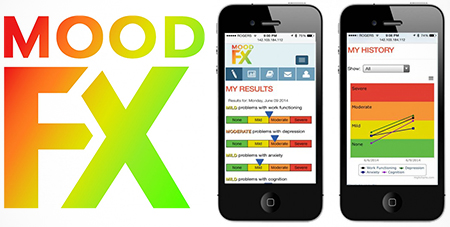
MoodFx is intended for Canadian workers but is available to the public for free at www.moodfx.ca. 

Researchers

Raymond Lam

Share:

  • Facebook
  • Linkedin
  • Twitter
  • Instagram
  • Email

Related Research Centres/Programs

Djavad Mowafaghian Centre for Brain Health

Get the latest research headlines in your inbox

Subscribe

Recent News and Stories

Type
Stories

Ask an expert: How can I strike a healthier balance with my daily habits?

Sep 10, 2026 mobility, exercise
Type
Stories

Moving endometrial cancer prevention upstream

Sep 8, 2026 endometriosis, women, preventative
Type
Stories

Improving respiratory protection for wildland firefighters

Sep 3, 2026 lung, safety
See more news

Get updates!

Join our newsletter mailing list to stay up to date on features and releases.

Subscribe

Quick Links

  • News and Stories
  • Careers
  • Events
  • Media Enquiries

Follow Us

  • LinkedIn
  • Instagram
  • Bluesky
  • YouTube

© 2026 VCHRI. All rights reserved.

  • Contact
  • Privacy Policy