A rewards-driven step-tracking app built healthy habits, mostly among the less active of a sizeable group of app users.
Gamifying daily fitness using carrots instead of sticks was the goal of a step-tracking smartphone app called Carrot Rewards. Under the direction of Dr. Guy Faulkner, a Vancouver Coastal Health Research Institute researcher and specialist in applied public health, researchers examined associations between the app’s micro-incentives and which users reached their daily step goals.

Involving 516,818 Carrot Rewards app users from Ontario, Canada, Faulkner’s study — published in the British Journal of Sports Medicine — revealed who experienced the greatest gains from finding their stride.
“We saw a sustained increase in the number of daily steps among individuals who had low-levels of activity before using the app,” shares Faulkner.
“This study demonstrated that there are clear benefits to engaging with interactive apps like Carrot Rewards to achieve public health objectives, such as increased daily activity, particularly among individuals who are less active.”
The commercially available smartphone app, further detailed in one of Faulkner’s previous studies, worked on both Android and Apple operating systems and was free to download on devices ranging from smartphones to Fitbits and a variety of smartwatches. The study took place between 2016 and 2019, prior to the COVID-19 pandemic.
After signing up for the app, participants underwent a one- to two-week baseline averaging period during which they were asked to have their device with them throughout the day as much as possible.
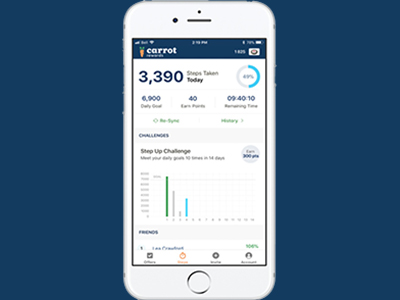
Photo courtesy of the National Library of Medicine
This baseline data became the floor upon which daily step goals were built throughout the intervention. When daily step goals were met, participants were rewarded with digital incentives in the form of loyalty points — redeemable at various companies for consumer goods, such as movie tickets or groceries. These in-app micro-financial incentives amounted to an average of $0.04 per person, per day.
Changing habits with short-term gains for long-term health
The concept for Carrot Rewards was grounded in behavioural economics and self-determination theory. In particular, researchers wanted to know how participants would respond to an economic opportunity, which, in this case, meant earning points for attaining daily step goals.
“Health behaviour change theories have often presumed that people make rational decisions and act in their own best interests,” explains Faulkner. “However, behavioural economics looks at unconscious behavioural processes that might lead to decisions that are counter to our best interests, forming discernible patterns that make these seemingly irrational decisions predictable.”
“For example, car dealerships often list the bare-bones version of a new car on the ticket price and then try to sell customers add-ons like air conditioning, a sunroof, a better sound system and so on,” Faulkner continues. “However, research shows that the opposite is more likely to result in a higher sale price.”
“In other words, people are more likely to buy a more expensive car with all the bells and whistles, rather than ‘giving up’ add-on features for a lower price.”
A principle of behavioural economics is that people tend to favour smaller, immediate rewards versus delayed gratification for their actions. In the case of fitness, this can take the form of opting to binge-watch a series rather than drag oneself to the gym, even though research shows that regular exercise is one of the best predictors of long-term health.
“Feeling good right now too often outweighs long-term health in people’s decision-making.”

As anticipated, roughly 40 per cent of Carrot Rewards app users increased their daily step counts by around 1,000 steps or more by the two-year mark. This finding included the approximately 50 per cent of individuals who were less active at baseline, which was benchmarked at taking less than 5,000 daily steps, on average.
“Given persistent global physical inactivity rates, these findings may be encouraging for fitness app users, health care providers, app publishing companies, researchers, governments and health insurers looking to promote healthier, more active living through fitness app intervention.”
One area of concern for Faulkner was whether providing incentives for physical activity could damage intrinsic motivation to exercise. Within self-determination theory, intrinsic motivation relates to people’s initiation of an activity driven by enjoyment of the activity itself and how much it forms part of their identity.
“Self-determination theory identifies three psychological needs that are crucial for optimal well-being,” Faulkner shares. “These needs are: 1) competence, such as a sense of feeling competent at learning new skills, 2) a sense of autonomy, such as the ability to choose things of your own free will and 3) social relatedness, such as opportunities for social interaction.”
However, Faulkner and his team found that, even after the app’s rewards incentives were discontinued, step count gains mostly remained.
“How and when reward incentives were available seemed to be less important to people than simply being able to continue to accumulate points.”
“Very active users were already motivated to exercise to begin with, so the app was perhaps less motivating or rewarding for them to continue to use to track their progress,” Faulkner says.
For monetary or points-based apps like Carrot Rewards to be sustainable in the long run, they need a stable funding model, Faulkner emphasizes. Longer-term public funding or other revenue sources should be identified from the outset, and strategies should be explored to rein in rewards to a manageable degree.
Faulkner’s study also indicates that receiving non-monetary points for meeting one’s goals can be equally motivating as monetary rewards. Fitness incentive strategies could build on this finding, optimizing incentives to achieve fitness goals without breaking the bank.
“Future iterations of the app that integrate artificial intelligence and potentially chat bots will lead to the further tailoring of these technologies to meet individual needs,” Faulkner says. “It could be like having a coach in your device, giving you the right encouragement at the right time to help you stay on track.”