This twist on couple therapy aims to unpack the relational dynamics that can contribute to low sexual desire and promote greater sexual satisfaction.
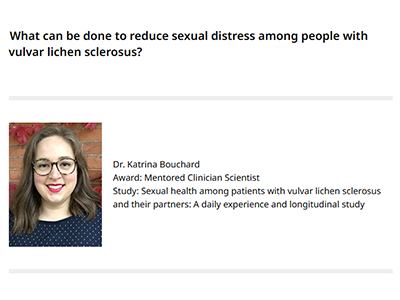
Up to 43 per cent of women will experience low sexual desire at some point in their lifetimes, often accompanied by significant distress and relationship strain. New research headed by Vancouver Coastal Health Research Institute researcher Dr. Katrina Bouchard is filling a gap in psycho-social care for this population, testing a new couple therapy designed specifically for those experiencing sexual interest/arousal disorder (SIAD).
“We know from research that women in long-term relationships are more likely to experience low sexual desire,” shares Bouchard.
“Low sexual desire and SIAD are among the most common reasons that partnered individuals go to sex and couple therapy.”
Individuals with SIAD experience distress and three or more of the following symptoms for at least six months: low sexual desire, few to no sexual thoughts, difficulties with physical sexual arousal, lack of pleasure during sex, little to no responsiveness to sexual cues and/or lack of initiation or receptivity to sex.

Bouchard’s feasibility study involved 19 couples in long-term relationships in which a female partner was diagnosed with SIAD. Couples completed 16 sessions of a novel cognitive-behavioural couple therapy (CBCT) intervention for SIAD developed by the research team.

“Raising awareness about low sexual desire is a really important piece of the puzzle to remove stigma and help connect individuals with appropriate care.”
CBCT is a well-established therapeutic approach based on similar principles to cognitive-behavioural therapy for individuals. When one person in a couple experiences a distressing health concern, CBCT targets unhelpful thoughts and behaviours, as well as the unique emotional experiences and difficulties, of both members of the couple. The approach tested in Bouchard’s research is designed specifically to promote dialogue and introduce couples to skills that support sexual desire/arousal and reduce sexual distress.
“We found that CBCT was highly acceptable, with almost every couple completing the program and reporting improvements in sexual desire and reduced distress that lasted six months after treatment,” says Bouchard. “Women with SIAD reported large improvements in sexual desire and sexual distress from pre-treatment to post-treatment, as well as six months later. Their partners reported moderate improvements in sexual distress post-treatment and small improvements six months later.”
Taking a couple-based approach to treating SIAD is a departure from standard practice, which has tended to focus on the partner with low sexual desire. This new approach focuses on both partners in a relationship, opening up an important avenue to enhance therapeutic interventions to treat low sexual desire and SIAD, says Bouchard.
Expanding research on low sexual desire couple therapy
Similar to Bouchard’s study, more research has begun to incorporate the interpersonal dynamic between partners in a relationship. “We know that the interpersonal context, or couple dynamic, is really important for people in partnered relationships, including in the areas of sexual desire and satisfaction,” Bouchard explains.
For example, people experiencing low sexual desire or SIAD may feel a sense of guilt or shame that can lead to feelings of isolation and sadness, which can negatively impact both the person with SIAD and their partner.
“Limited existing research tells us that women in partnered relationships are around five times more likely than single women to experience distressing low sexual desire,” notes Bouchard.
“We see similar rates of low sexual desire among transgender women and gender-diverse individuals assigned female at birth, which is why therapies need to be inclusive of women and gender-diverse people.”
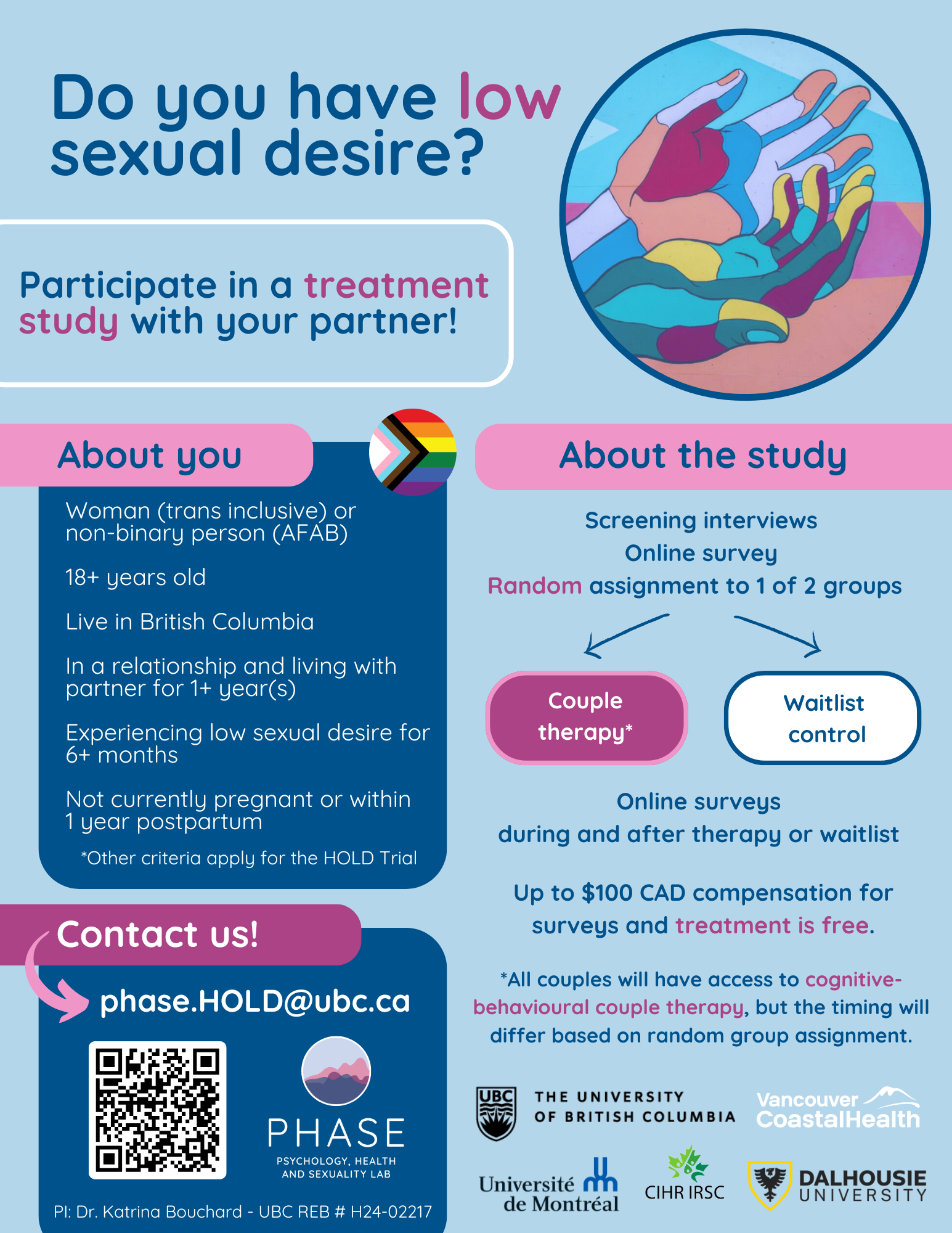
Building on the results of their initial feasibility study, Bouchard and her team are presently enrolling 170 couples from across Canada in their Helping with Outcomes for Low Desire (HOLD) Trial — the first randomized clinical trial in Canada to test a standardized couple-based therapy for SIAD. The HOLD Trial will further test and validate the CBCT intervention for couples experiencing low sexual desire/arousal, with couples enrolled in the control arm of the study given access to the therapy later on.