Main menu

  • About Us
    • Leadership
    • Our Team
    • Vision, Mission and Values
    • Health and Economic Impact
    • Research Impact Video
    • Strategic Plan
  • Our Research
    • Research Focus
      • Brain Health
      • Cancer
      • Digital Health and Artificial Intelligence
      • Heart Health
      • Healthy Aging and Mobility
      • Immune System
      • Injury and Rehabilitation
      • Lung Health
      • Mental Health and Substance Use
    • Research Centres and Programs
      • BC Centre on Substance Use
      • Centre for Aging SMART
      • Centre for Clinical Epidemiology and Evaluation
      • Centre for Lung Health
      • Dilawri Cardiovascular Institute
      • Djavad Mowafaghian Centre for Brain Health
      • Immunity and Infection Research Centre
      • International Collaboration On Repair Discoveries
      • M. H. Mohseni Institute of Urologic Sciences
      • Ovarian Cancer Research Centre
      • Community Research Program
      • Emergency Medicine Research Program
      • Hematology Research Program
      • Skin Research Program
      • Other Research Focus Areas
    • News and Stories
    • Researcher Directory
    • Events and Workshops
  • Research Services
    • New to VCHRI
      • Working at VCHRI
      • Regulations and Training
      • Membership with VCHRI
      • Learning and Development
    • Starting Your Project
      • Research Facilitation
      • Awards and Funding
      • Grant Management
      • Operational Approval
      • CST Cerner
    • Developing Your Project
      • Clinical Trials Administration
      • Clinical Research Unit
      • Research Privacy
      • Financial Policies and Procedures
    • Additional Support
      • Indigenous Health Research Unit
      • VCH-VCHRI AI Hub
      • Communications and Media Relations
      • Study Recruitment Support
      • Innovation and Industry Partnership
    • Internal Awards
    • Clinical Research
    • Indigenous Research
  • Participate in Research
    • Reasons to Participate
    • Participant Stories
    • Find a Study
    • Recruitment Support

User menu

  • Log in

Breadcrumb

  1. Home
  2. Our Research
  3. News and Stories
  4. People in profile: Alvin Kimbowa

People in profile: Alvin Kimbowa

Stories Feb 18, 2026 3 minutes

Meet Alvin — A biomedical engineering student who is using artificial intelligence to expand access to quality medical imaging in communities with limited resources.

Q: What is your role in health research? 
A:
I am a graduate student in the Ultrasound Technology and AI for Healthcare Laboratory, where I study how artificial intelligence (AI) can support knee osteoarthritis assessment using point-of-care ultrasound devices. My goal is to develop objective tools for community-based screening, detection and monitoring of knee osteoarthritis, particularly for high-risk groups such as athletes with knee injuries, First Nations communities or older adults. 

Q: What does your average day at work look like? 
A:
Most of my days are spent at my desk in the lab writing and debugging code, running experiments and analyzing results. I also take part in data collection using different ultrasound devices and integrate my algorithms into those systems. Seeing the models operate in real time is both exciting and fulfilling. 

Q: What is your research area of interest, and what led you to that interest? 
A:
My passion for AI in medical imaging began during my undergraduate studies in Uganda, where I learned about the significant shortage of radiologists. At the time, there were only 48 radiologists in the country, which is roughly one radiologist for every million people. By contrast, British Columbia has about 316 radiologists, or 58 per million. While experimenting with AI during my undergraduate degree, I saw how this technology had the potential to expand access to diagnostic expertise in Uganda and other low-resource settings around the world. 

Q: What was your first job? 
A:
I worked as a machine learning engineer at the Marconi Lab at Makerere University right after my undergraduate studies. I contributed to projects on automated prostate cancer screening in MRI images, medical instrument detection in ultrasound images and a national AI-enabled screening platform. This experience motivated me to pursue graduate studies in biomedical engineering and focus on building clinical-grade AI tools for health care. 

Q: What is one of the biggest accomplishments or proudest moments of your career so far? 
A:
Being accepted into graduate school at UBC and transferring into the PhD program without first completing a master’s degree is one of my proudest accomplishments. I vividly remember defending my proposal during the comprehensive exam and receiving unanimous approval from my supervisory committee to transfer to the PhD program. 
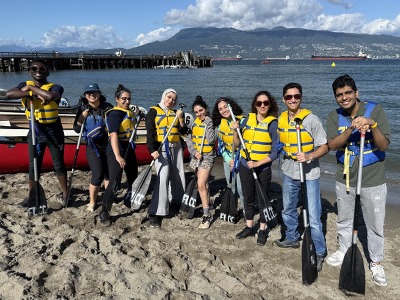
Alvin and his colleagues enjoy spending time together outside the lab, including participating in UBC’s Day of the LongBoat and skating at the UBC ice rink.

Q: What do you do for fun in your spare time? 
A:
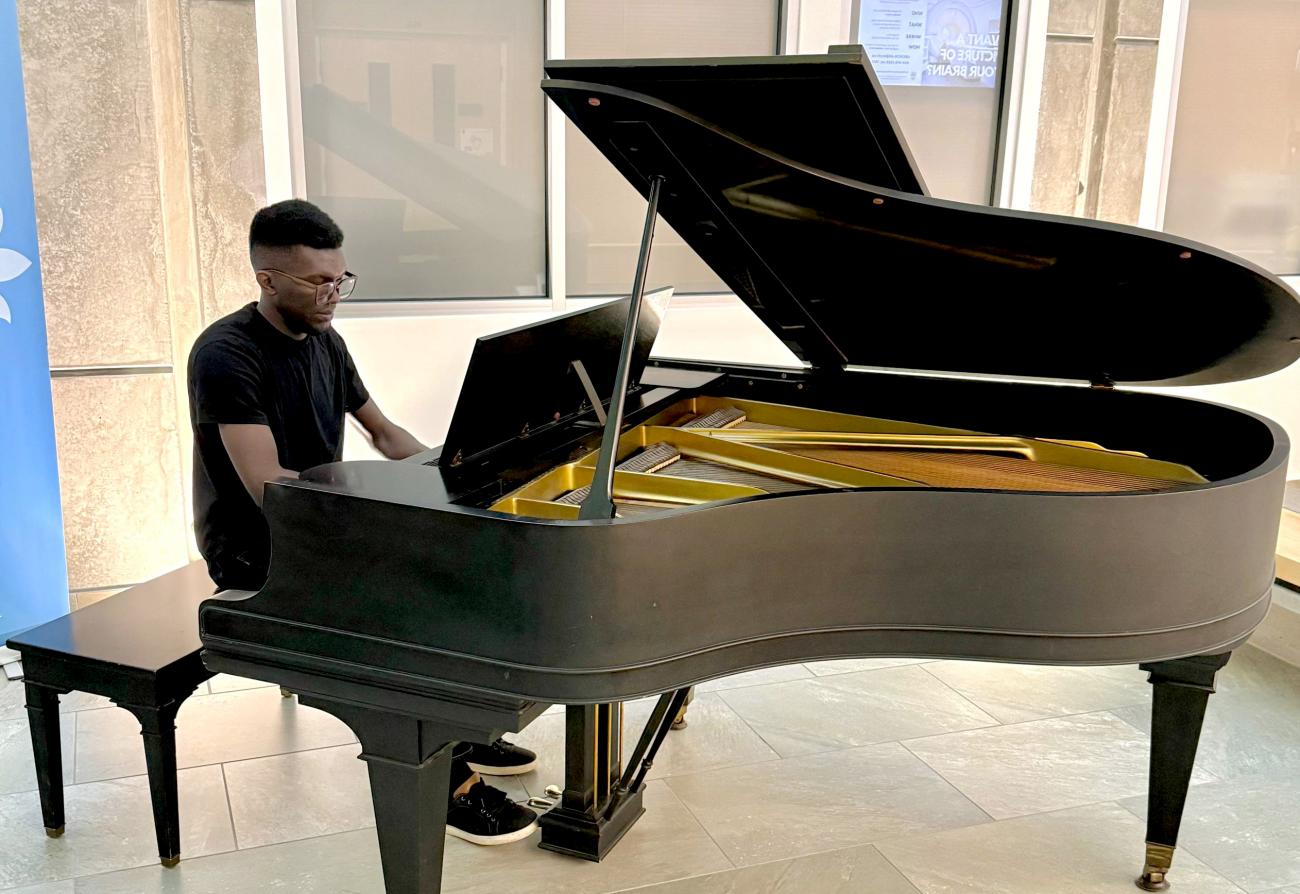
I love playing the piano. One of the research centers I am affiliated with, the Djavad Mowafaghian Centre for Brain Health, has a piano, and I often take breaks during the day to play. 

Q: What is your favourite movie? 
A:
My favourite movie is Interstellar. It explores many classic sci-fi themes I enjoy, including space, time and the evolution of human knowledge. In fact, one of the reasons I started learning piano was so I could play the Interstellar theme song! 

Q: Who motivates you? 
A:
My parents are my inspiration. My dad and mum are incredibly hardworking. They had big dreams for me and sacrificed so much to support my success, and for that I am forever grateful. 

Q: If you could travel anywhere in the world right now, where would you go? 
A:
I would visit the Colosseum in Rome. I am fascinated by human civilization, and Italy — as the centre of the Roman Empire — would be an incredible place to explore that history. 

Q: What piece of advice would you give your younger self? 
A:
I would tell myself to believe in abilities and set more ambitious goals. As Michelangelo said, “The greatest danger for most of us is not that our aim is too high and we miss it, but that it is too low and we reach it.” 
Alvin Kimbowa is a PhD candidate in biomedical engineering at the University of British Columbia under the guidance of Dr. Ilker Hacihaliloglu. He holds a Bachelor of Science in electrical engineering from Makerere University. Growing up in Kawempe, a densely populated suburb of Kampala, Uganda, shaped his resilience, ambition and commitment to improving health care access for underserved communities. His research focuses on developing AI solutions for real-time assessment of musculoskeletal disorders using point-of-care ultrasound.


Researchers

Ilker Hacihaliloglu

Related Articles

Welcoming Dr. Stirling Bryan: A Q&A with VCHRI Interim Executive Director

People in profile: Adam Sunavsky

Mentorship and care shaping the VCHRI Research Challenge

Share:

  • Facebook
  • Linkedin
  • Email

Related Research Centres/Programs

Centre for Aging SMART

Get the latest research headlines in your inbox

Subscribe

Recent News and Stories

Type
Stories

Early detection of lung attacks in COPD

Feb 21, 2026 COPD, technology, preventative
Type
Announcement

Harnessing AI to improve ovarian cancer outcomes

Feb 19, 2026 artificial intelligence, ovarian
Type
Stories

Welcoming Dr. Stirling Bryan: A Q&A with VCHRI Interim Executive Director

Feb 17, 2026 people feature
See more news

Get updates!

Join our newsletter mailing list to stay up to date on features and releases.

Subscribe

Quick Links

  • News and Stories
  • Careers
  • Events
  • Media Enquiries

Follow Us

  • LinkedIn
  • Instagram
  • Bluesky
  • YouTube

© 2026 VCHRI. All rights reserved.

  • Contact
  • Privacy Policy