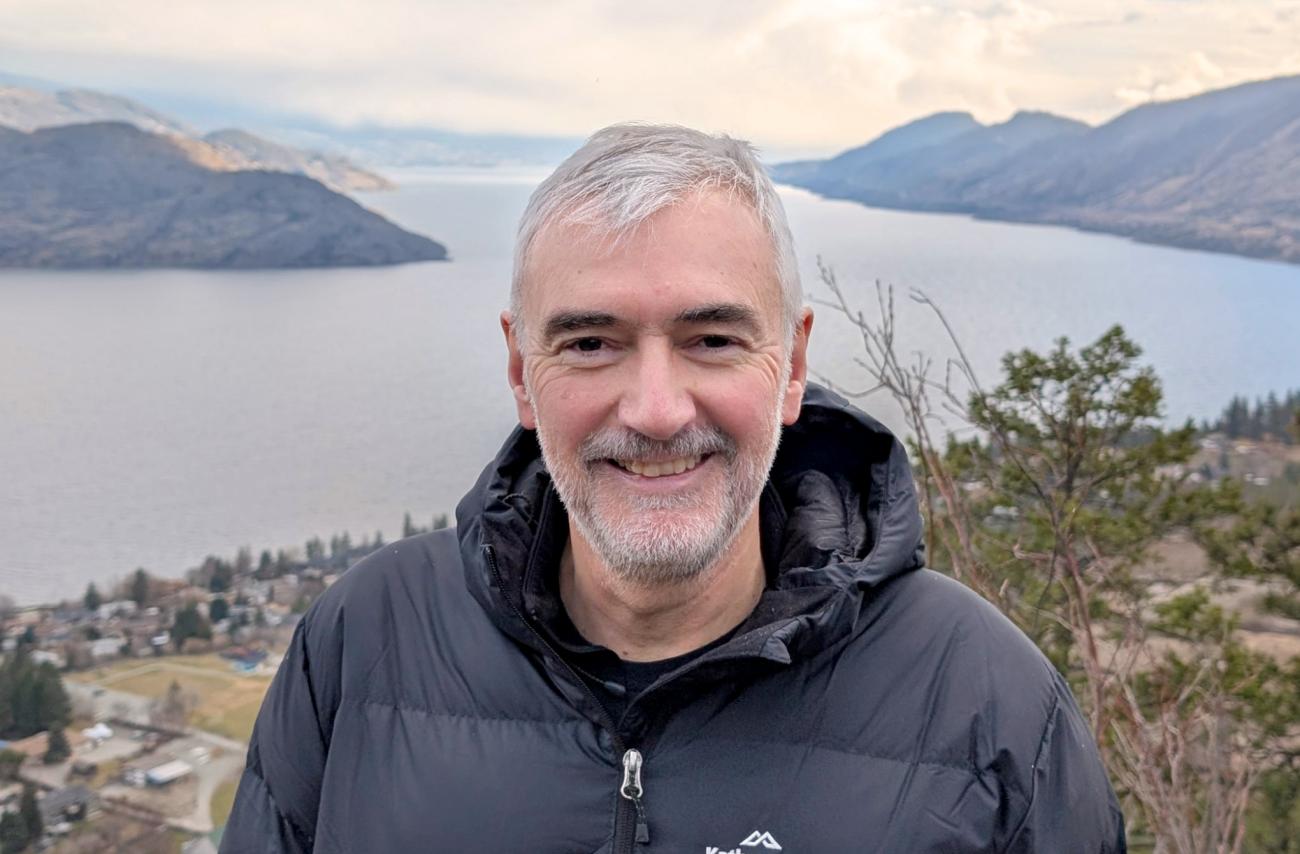
Dr. Stirling Bryan steps into a pivotal leadership role, strengthening the integration of health system and patient perspectives into research and health policy.
Vancouver Coastal Health Research Institute (VCHRI) is pleased to welcome Dr. Stirling Bryan as Interim Executive Director, effective February 2026. A distinguished health economist, Dr. Bryan’s work has helped shape health system policy and build capacity for patient-oriented research across British Columbia. His leadership experience spans academic, health system and provincial research organizations, with a strong track record in economic evaluation, health technology assessment and evidence-informed decision-making.
We spoke with Dr. Bryan about his leadership philosophy and his vision for VCHRI’s evolving role within British Columbia’s health research ecosystem.
Q: What are you most looking forward to in your new role?
A: VCHRI has been part of my professional life since 2008, so stepping into this role feels both meaningful and personal. The research institute has been a constant thread throughout my career in Canada, and I see this as an opportunity to contribute to its next chapter in a more intentional way.
What excites me most is working alongside a community of researchers, clinicians, patients and leaders who care deeply about improving care and outcomes for the people we serve. As one of the top funded research institutes in Canada, VCHRI has strong foundations, and I’m looking forward to building on those strengths to sharpen our shared sense of purpose and impact.
I believe research should be woven into the fabric of health care, shaping how care is designed and delivered every day. If we can continue to nurture that culture — through innovation, meaningful engagement and strong interdisciplinary partnerships — we will show how research can make a tangible difference for patients and for the health system as a whole.
Q: What excites you most about the future of health research in British Columbia?
A: We are living in a time of significant turbulence, and British Columbia is navigating the same fiscal and system pressures shaping health care systems globally. That context makes it even more important that our work is relevant, timely and responsive.
What gives me optimism is the momentum I see around research that truly matters — research that responds to policy priorities, clinical practice and the lived experiences of patients and communities. Increasingly, studies are being designed not only to generate knowledge or improve treatment options, but to co-develop solutions to pressing challenges in the health system.
Across VCHRI, there are powerful examples of what becomes possible when research is done with people, not just for them. In my own work, we are seeing how genetic testing can help tailor depression treatment to individual patients, improving outcomes while also reducing unnecessary trial-and-error prescribing and the strain this places on the health system.
This kind of patient-informed, clinically relevant research reflects a broader shift across our research community. It puts us in a strong position to advance people-centred research and to demonstrate how evidence can drive practical improvements in care.
Q: What do you see as key priorities for VCHRI moving forward? What role do you see it playing in the evolution of research and care?
A: One of my top priorities is to strengthen how VCHRI supports knowledge translation — making sure that research findings move more reliably and more quickly into clinical care and everyday practice. I’m particularly focused on advancing a Learning Health System approach, where evidence generation, implementation and improvement form a continuous cycle rather than a series of discrete steps.
Alongside this, I see an opportunity to deepen our sense of community across VCHRI. Our research institutes, centres and programs, along with shared core services such as the Clinical Research Unit and AI Hub, are essential assets. I want us to connect these resources more intentionally across the full spectrum of research activity so that teams feel both well supported and part of a larger, coherent whole.
We are already seeing encouraging examples of this in action. For example, Learning Health System work at VCH has brought together patient partners, long-term care clinicians and researchers to review and improve antipsychotic reduction strategies in VCH long-term care facilities. Projects like these — where leadership, researchers, care teams and patients co-design and test evidence-informed solutions in real-world settings — illustrate the vital bridging role VCHRI can play between research and care. They also show how learning and improvement can become part of routine practice.
Q: What do you value most in your colleagues and collaborators?
A: Above all, I value alignment around purpose. The strongest collaborations come from people who share a commitment to impact and to making a difference beyond their individual projects or disciplines.
Trust is also fundamental. Research is complex and progress depends on people being open, transparent and willing to learn from one another. I admire colleagues who bring curiosity and humility to their work and who see collaboration with patients and communities as essential, not optional.
When teams share a vision and a sense of responsibility to those they serve, the work becomes more than research. It becomes a collective effort to improve health and care.
Q: Outside of work, how do you unwind or stay grounded?
A: I read most evenings. I’m drawn to novels — Ian McEwan is a particular favourite — because his storytelling captures the complexity of people and real life in ways that resonate with me. I once even took part in a randomized trial looking at whether reading before bed improves sleep, and I have to say the findings were persuasive for me personally.
Q: Is there a quote or principle that continues to guide you in leadership?
A: A principle that has become increasingly important to me is the idea of “unlearning,” particularly in the context of Indigenous reconciliation and broader equity and anti-racism work. I want to acknowledge the work of Drs. Kate Jongbloed and Daniele Behn Smith for creating the Unlearning Club focused on unlearning and undoing systemic white supremacy and Indigenous-specific racism. My exposure to this work, through the Unlearning Club running at Health Research BC, has had a big impact on me.
I grew up in Birmingham in the 1960s during a time of significant social and racial tension around immigration. I was surrounded by strong and often polarized views, and as I’ve grown older, I’ve come to realize that binary ways of thinking are not helpful in the society we live in today.
Leadership requires recognizing racism and inequality where they exist within our systems and organizations and making a proactive effort to change them. For me, that means listening, reflecting and being willing to challenge assumptions, including my own, as part of an ongoing process of learning and unlearning.
If we are serious about building a research environment that is inclusive, respectful and truly serves all communities, this work cannot sit at the margins. It has to be central to how we think about research, how we build teams and how we define success.