Main menu

  • About
    • Leadership
    • Our Team
    • Vision, Mission and Values
    • Health and Economic Impact
    • Strategic Plan
    • News and Stories
    • Careers
  • Research
    • Research Focus
      • Brain Health
      • Cancer
      • Digital Health
      • Healthy Aging and Mobility
      • Heart Health
      • Immune System
      • Injury and Rehabilitation
      • Lung Health
      • Mental Health and Substance Use
      • Other Research Focus Areas
    • Research Centres and Programs
      • BC Centre on Substance Use
      • Centre for Aging SMART
      • Centre for Clinical Epidemiology and Evaluation
      • Centre for Lung Health
      • Dilawri Cardiovascular Institute
      • Djavad Mowafaghian Centre for Brain Health
      • International Collaboration On Repair Discoveries
      • M. H. Mohseni Institute of Urologic Sciences
      • Ovarian Cancer Research Centre
      • Community Research Program
      • Emergency Medicine Research Program
      • Hematology Research Program
      • Skin Research Program
    • Research Cores
      • Clinical Trials Platform
      • VCH-VCHRI AI Hub
      • Indigenous Health Research Unit
    • Researcher Directory
    • Events and Workshops
    • Participate in Research
  • Research Services
    • New to VCHRI
      • Working at VCHRI
      • Regulations and Training
      • Membership with VCHRI
    • Research Development
      • Awards and Funding
      • Research Facilitation
      • Grant Management
      • Learning and Development
    • Contracts and Compliance
      • Contract Facilitation at VCHRI
      • Operational Approval
      • Research Privacy
      • Clinical Trials Administration
    • Research Support
      • Communications and Media Relations
      • Financial Policies and Procedures
      • VCH-VCHRI AI Hub
    • Internal Awards
    • Clinical Research
    • Indigenous Research
  • Clinical Trials
    • Clinical Trials Platform
      • Phase 1 Clinical Trials Research Unit
      • Hematology Research Unit
      • Clinical Research Unit
    • Find a Study
    • Researcher Directory
  • Participate in Research
    • Reasons to Participate
    • Participant Stories
    • Find a Study
    • Recruitment Support

User menu

  • Log in

Breadcrumb

  1. Home
  2. Research
  3. Participate in Research
  4. Study finds narrowing of veins is not unique to people with MS

Study finds narrowing of veins is not unique to people with MS

Stories Oct 8, 2013 3 minutes

First study in the world to find high rates of venous narrowing in general population. Research results confirm that venous narrowing is not associated with multiple sclerosis.

Multiple Sclerosis (MS) is the leading cause of neurological disability in the world1.  Canadians have one of the highest rates of MS and three Canadians are diagnosed with MS every day2. The disease randomly attacks the myelin coating of nerves in the brain, optic nerves and spinal cord causing permanent scaring.  MS patients are in need for treatments that can make a difference in their quality of life — this is the driving force in health and medical research.

Initial reports indicated that all patients with MS have chronic cerebrospinal venous insufficiency (CCSVI), the narrowing of the veins leading from the brain to the heart.  First put forth by Dr. Paolo Zamboni in Italy in 2009, the study claimed that MS is associated with CCSVI, and that some MS patients can be effectively treated by angioplasty to widen the veins. However, all prevalent studies have been limited to the imaging techniques of ultrasound without validation from catheter venography, which has the advantage of direct visualization of venous anatomy.
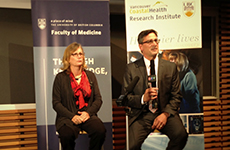


Dr. Anthony Traboulsee, director of the MS Clinic at UBC Hospital of Vancouver Coastal Heath and associate professor of Division of Neurology at UBC, uses the ‘gold standard’ imaging technique — catheter venography — to investigate the CCSVI theory by directly visualizing the veins of people with MS, their unaffected siblings and unrelated healthy research participants.  The results, published in the U.K. medical journal The Lancet, confirm that venous narrowing is not a unique anatomical feature associated with MS.

Dr. Traboulsee’s research team, in collaboration with the University of Saskatchewan, calls into question the basis for a controversial theory that there is an association between venous narrowing and MS. 177 study participants enrolled in the study between January 2011 and March 2012. Traboulsee’s team found venous narrowing in 74% of people with MS, 66% of their unaffected siblings, and 70% of the unrelated research volunteers. “Our results confirm that venous narrowing is a frequent finding in the general population. This is the first study to find high rates of venous narrowing in a healthy control group as well as the first to show that the ultrasound criteria usually used to ‘diagnose’ CCSVI are unreliable,” says Dr. Traboulsee.

The research study addresses the need for carefully designed and high quality research technology and methodology to fully investigate new theories of MS.

Click here for the abstract of the article published in The Lancet on October 8, 2013.

REFERENCE:

1Multiple Sclerosis International Federation. What is MS? http://www.msif.org/about-ms/what-is-ms-1.aspx
2Multiple Sclerosis Society of Canada. About MS. http://mssociety.ca/en/information/default.htm


Researchers

Anthony Traboulsee

Share:

  • Facebook
  • Linkedin
  • Twitter
  • Instagram
  • Email

Related Research Centres/Programs

Djavad Mowafaghian Centre for Brain Health

Get the latest research headlines in your inbox

Subscribe

Recent News and Stories

Type
Stories

Ask an expert: How can I strike a healthier balance with my daily habits?

Sep 10, 2026 exercise, mobility
Type
Stories

Moving endometrial cancer prevention upstream

Sep 8, 2026 women, cancer, uterine
Type
Stories

Improving respiratory protection for wildland firefighters

Sep 3, 2026 lung, environment, safety
See more news

Get updates!

Join our newsletter mailing list to stay up to date on features and releases.

Subscribe

Quick Links

  • News and Stories
  • Careers
  • Events
  • Media Enquiries

Follow Us

  • LinkedIn
  • Instagram
  • Bluesky
  • YouTube

© 2026 VCHRI. All rights reserved.

  • Contact
  • Privacy Policy