Main menu

  • About
    • Leadership
    • Our Team
    • Vision, Mission and Values
    • Health and Economic Impact
    • Strategic Plan
    • News and Stories
    • Careers
  • Research
    • Research Focus
      • Brain Health
      • Cancer
      • Digital Health
      • Healthy Aging and Mobility
      • Heart Health
      • Immune System
      • Injury and Rehabilitation
      • Lung Health
      • Mental Health and Substance Use
      • Other Research Focus Areas
    • Research Centres and Programs
      • BC Centre on Substance Use
      • Centre for Aging SMART
      • Centre for Clinical Epidemiology and Evaluation
      • Centre for Lung Health
      • Dilawri Cardiovascular Institute
      • Djavad Mowafaghian Centre for Brain Health
      • International Collaboration On Repair Discoveries
      • M. H. Mohseni Institute of Urologic Sciences
      • Ovarian Cancer Research Centre
      • Community Research Program
      • Emergency Medicine Research Program
      • Hematology Research Program
      • Skin Research Program
    • Research Cores
      • Clinical Trials Platform
      • VCH-VCHRI AI Hub
      • Indigenous Health Research Unit
    • Researcher Directory
    • Events and Workshops
    • Participate in Research
  • Research Services
    • New to VCHRI
      • Working at VCHRI
      • Regulations and Training
      • Membership with VCHRI
    • Research Development
      • Awards and Funding
      • Research Facilitation
      • Grant Management
      • Learning and Development
    • Contracts and Compliance
      • Contract Facilitation at VCHRI
      • Operational Approval
      • Research Privacy
      • Clinical Trials Administration
    • Research Support
      • Communications and Media Relations
      • Financial Policies and Procedures
      • VCH-VCHRI AI Hub
    • Internal Awards
    • Clinical Research
    • Indigenous Research
  • Clinical Trials
    • Clinical Trials Platform
      • Phase 1 Clinical Trials Research Unit
      • Hematology Research Unit
      • Clinical Research Unit
    • Find a Study
    • Researcher Directory
  • Participate in Research
    • Reasons to Participate
    • Participant Stories
    • Find a Study
    • Recruitment Support

User menu

  • Log in

Breadcrumb

  1. Home
  2. Research
  3. Participate in Research
  4. Tourniquet exercises boosted strength in people with spinal cord injury

Tourniquet exercises boosted strength in people with spinal cord injury

Stories Jan 22, 2025 3 minutes

The novel approach shows promise as a means to build muscle force while reducing the risk of injury present in other modalities.

People with spinal cord injury (SCI) are at greater risk of severe muscle weakness than their non-SCI peers, with maintaining adequate muscle mass essential to prevent muscle wasting and atrophy. In a study led by Vancouver Coastal Health Research Institute researcher Dr. Babak Shadgan, blood flow restriction (BFR) exercise — used by athletes such as bodybuilders — enabled people with SCI to gain strength using lighter weights, while also reducing their risk of injury.

“Building and maintaining upper body muscle mass through strength-training exercise can facilitate daily tasks among people with SCI, such as propelling a wheelchair, making a meal or dressing,” notes Shadgan. 

“We found that low-intensity exercise with BFR shows promise as a means for people with SCI to build muscle strength and achieve greater quality of life.”

High-intensity interval training (HIIT) and strength training are proven ways to build muscle mass; however, HIIT and lifting heavier weights also come with an increased risk of injury, says Shadgan. “HIIT in particular can lead to overuse injuries that limit range of motion, limb function and/or reduce strength, as well as cause pain or discomfort.”

“Many high-performance athletes, such as wrestlers, soccer players and weightlifters, use BFR training, which led me to wonder if this approach could help people with SCI.”

Research has pointed to a connection between BFR exercise and chemical responses in the body, particularly through the endocrine system and muscle activation. However, the physiological mechanisms underpinning the effectiveness of BFR is an ongoing area of investigation.

A home-based, portable application is being explored

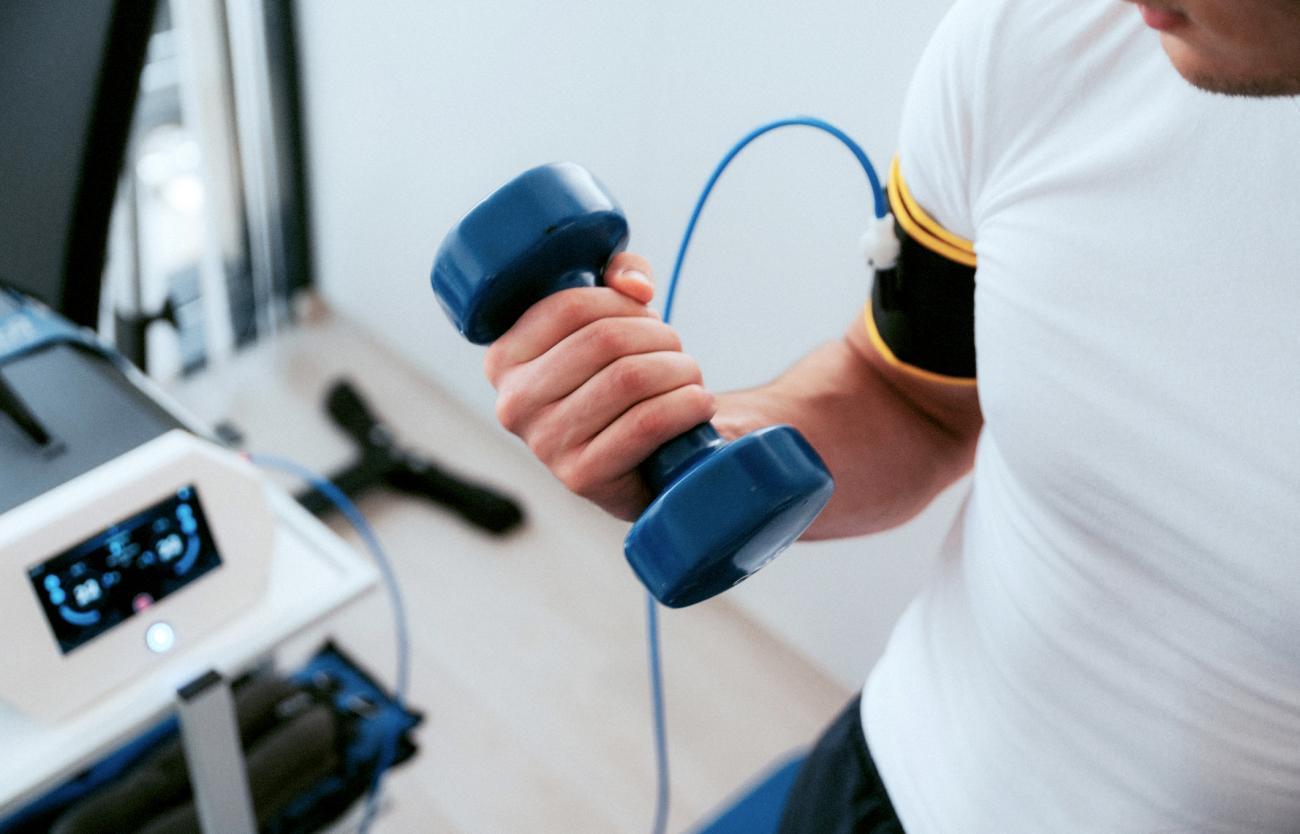
Shadgan’s study is the first comprehensive investigation of its kind in the SCI population. Researchers placed a personalized tourniquet system around the arms of 10 SCI participants who performed four sets of wrist-curl exercises of 30, 15, 15 and 15 repetitions each twice per week for eight weeks. 

Dr. Babak Shadgan is an assistant professor in the Department of Orthopaedics and an associate faculty member at the School of Biomedical Engineering at the University of British Columbia. He is also a principal investigator at ICORD, where he directs the Implantable Biosensing Laboratory.

A pre-assessment determined the maximum weight that each participant could curl one time. Participants were randomly assigned a right or left test arm, which was wrapped with a personalized tourniquet, restricting blood flow to 60 per cent of complete blood flow stoppage. 

Participants then curled an adjustable dumbbell weighing 30 per cent of their one-rep maximum. For example, if their one-rep maximum was 30 pounds, the participant would lift 10 pounds with their test arm. With their other ‘control’ arm, participants lifted a dumbbell weighing 50 per cent less than their one-rep maximum. 
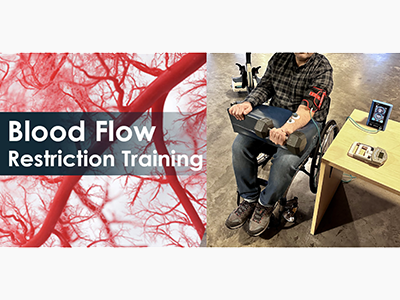
Study participants used weights with both arms, but BFR was tested on only one side.

By the end of the study, participants significantly increased their forearm muscle strength on the low-intensity BFR test side, lifting on average 7.5 kilograms more than they could at baseline. On their control arm side, participants could lift only around 4.4 kilograms more. 

“We have now validated an exercise program that is safe and effective for people with SCI.” 

Researchers also monitored participants’ heart rates and blood pressure while exercises were performed, finding that all participants remained within safe ranges of blood pressure during the experiment.

Many participants expressed that they experienced improvements in their daily activities and health status. One participant shared with the research team: “I have noticed a huge improvement in my strength and ability to push my wheelchair. Also, my strength in grip and opening things has improved. Overall, I am so happy with the results. I definitely notice a difference in my daily life.”

“It has improved my ability in my daily activities such as gardening, handling my cup of coffee and swimming.”

The study team is now exploring a home BFR setup involving a compact tourniquet device and an adjustable weight and tablet-based platform that could be used by people with SCI with the remote or virtual support of a trainer or physical therapist.


Researchers

Babak Shadgan

Related Articles

Navigating breastfeeding after spinal cord injury

Behind the lab doors: Investigating blood biomarkers as a window into brain health at Wellington Laboratory

Revolutionizing powered wheelchair training for spinal cord injury recovery

Share:

  • Facebook
  • Linkedin
  • Twitter
  • Instagram
  • Email

Related Research Centres/Programs

International Collaboration on Repair Discoveries

Get the latest research headlines in your inbox

Subscribe

Recent News and Stories

Type
Stories

Ask an expert: How can I strike a healthier balance with my daily habits?

Sep 10, 2026 exercise, mobility
Type
Stories

Moving endometrial cancer prevention upstream

Sep 8, 2026 women, cancer, uterine
Type
Stories

Improving respiratory protection for wildland firefighters

Sep 3, 2026 lung, environment, safety
See more news

Get updates!

Join our newsletter mailing list to stay up to date on features and releases.

Subscribe

Quick Links

  • News and Stories
  • Careers
  • Events
  • Media Enquiries

Follow Us

  • LinkedIn
  • Instagram
  • Bluesky
  • YouTube

© 2026 VCHRI. All rights reserved.

  • Contact
  • Privacy Policy