
Main menu

  • About
    • Leadership
    • Our Team
    • Vision, Mission and Values
    • Health and Economic Impact
    • Strategic Plan
    • News and Stories
    • Careers
  • Research
    • Research Focus
      • Brain Health
      • Cancer
      • Digital Health
      • Healthy Aging and Mobility
      • Heart Health
      • Immune System
      • Injury and Rehabilitation
      • Lung Health
      • Mental Health and Substance Use
      • Other Research Focus Areas
    • Research Centres and Programs
      • BC Centre on Substance Use
      • Centre for Aging SMART
      • Centre for Clinical Epidemiology and Evaluation
      • Centre for Lung Health
      • Dilawri Cardiovascular Institute
      • Djavad Mowafaghian Centre for Brain Health
      • International Collaboration On Repair Discoveries
      • M. H. Mohseni Institute of Urologic Sciences
      • Ovarian Cancer Research Centre
      • Community Research Program
      • Emergency Medicine Research Program
      • Hematology Research Program
      • Skin Research Program
    • Research Cores
      • Clinical Trials Platform
      • VCH-VCHRI AI Hub
      • Indigenous Health Research Unit
    • Researcher Directory
    • Events and Workshops
    • Participate in Research
  • Research Services
    • New to VCHRI
      • Working at VCHRI
      • Regulations and Training
      • Membership with VCHRI
    • Research Development
      • Awards and Funding
      • Research Facilitation
      • Grant Management
      • Learning and Development
    • Contracts and Compliance
      • Contract Facilitation at VCHRI
      • Operational Approval
      • Research Privacy
      • Clinical Trials Administration
    • Research Support
      • Communications and Media Relations
      • Financial Policies and Procedures
      • VCH-VCHRI AI Hub
    • Internal Awards
    • Clinical Research
    • Indigenous Research
  • Clinical Trials
    • Clinical Trials Platform
      • Phase 1 Clinical Trials Research Unit
      • Hematology Research Unit
      • Clinical Research Unit
    • Find a Study
    • Researcher Directory
  • Participate in Research
    • Reasons to Participate
    • Participant Stories
    • Find a Study
    • Recruitment Support

User menu

  • Log in

Breadcrumb

  1. Home
  2. Research
  3. Participate in Research
  4. New guide for patients with treatment-resistant depression

New guide for patients with treatment-resistant depression

Stories Feb 2, 2022 3 minutes

A study focused on patient experience offers a clearer picture of the most common side effects associated with two groundbreaking rTMS protocols.

The loss of her brother sunk lawyer Lisa Ridgway into a deep depression that was resistant to standard treatments. Open to alternative options, Ridgway received the novel repetitive transcranial magnetic stimulation (rTMS) therapy, which gave her hope and set her on a path to becoming a patient partner in a first-of-its-kind study led by Vancouver Coastal Health Research Institute researcher Dr. Fidel Vila-Rodriguez.

“Being involved in that study was very important to me because it can help to inform patients — from bench to bedside,” says Ridgway. “The approach taken for this study shows that patients come first.”

Lisa Ridgway is an advocate for patient-oriented research and mental health care issues. She currently collaborates with teams at the University of British Columbia (UBC) and the University of Victoria.

The non-invasive rTMS therapy involves applying a series of magnetic pulses to specific areas of the brain to stimulate and change the firing patterns of brain circuits. Shown in prior studies to be a successful first-line intervention for people with treatment-resistant depression, rTMS is believed to be able to rewire the brain to help relieve symptoms. 

Depression — characterized by such feelings as emptiness, fatigue and suicidality — affects around 5.4 per cent of Canadians, and around 30-40 per cent will develop a form that does not respond to medication or counselling. 

Vila-Rodriguez’s secondary trial — published in the journal, Brain Stimulation — is the first known study to compare the pain and side effects associated with two protocols of rTMS — intermittent theta burst stimulation (iTBS) and high-frequency left (HFL) — for treatment-resistant depression. iTBS is a newer protocol that delivers three bursts of magnetic pulses at a frequency of 50 Hz over the course of three minutes. HFL delivers pulses over the course of 37.5 minutes at a level of 10 Hz.
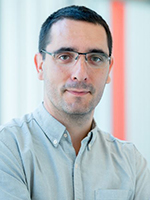
Dr. Fidel Vila-Rodriguez is the director of the Non-Invasive Neurostimulation Therapies (NINET) Laboratory, a clinician-scientist with the Djavad Mowafaghian Centre for Brain Health and an assistant professor in the Department of Psychiatry at UBC.

Vila-Rodriguez’s study reviewed data collected in the THREE-D trial that included 414 adult participants between the ages of 18 and 65 who randomly received either HFL or iTBS. Vila-Rodriguez’s research team found that reported pain severity decreased significantly over the course of treatment using both protocols, although iTBS was found to be more uncomfortable. 

Participants who were older, female and had high anxiety levels also experienced more pain. Although, the greater the positive response to the treatment, the less pain patients reported experiencing, Vila-Rodriguez’s research found. 

Patient perspective helps move research into clinical practice

Ridgway and Vila-Rodriguez initially connected through the social media platform Twitter after Ridgway posted about her experience receiving rTMS.

“When I first went through the treatment, I did not realize that there could be pain or side effects associated with the procedure,” recalls Ridgway. “I had very minimal side effects or pain. And, after several treatments, it became almost a meditative experience and quite relaxing.”

Ridgway’s journey soon led her into the realm of patient-oriented research, where she became involved in studies associated with mental illness and health care. Now a patient partner with Vila-Rodriguez’s NINET Lab, Ridgway provides essential insight into lived experience and patient perspective to help shape the user-friendliness of research materials.

“Since Lisa joined the NINET Lab as a patient-partner, staff and myself have all become more aware of the importance of translating research into clinical practice.”   

Vila-Rodriguez and the NINET Lab consulted with Ridgway on the language used in the study, along with an infographic that illustrates the study’s findings.
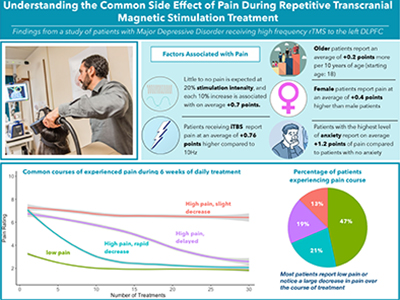
The findings of Vila-Rodriguez’s research were translated into an easy-to-interpret infographic to support the decision-making process of patients when rTMS is being considered.

“When we produced the first draft of the paper, it read more like a standard science paper with a lot of technical terminology and clinical language,” recalls Vila-Rodriguez. “Lisa’s insights shifted the tone, enriching it with more functional information and plain language that put the people who will receive the treatment at the forefront.” 

Vila-Rodriguez’s infographic will be printed off as a poster for installation in treatment rooms where psychiatrists and clinicians can reference them when describing rTMS and its common side effects.


 

Researchers

Fidel Vila-Rodriguez

Related Articles

On-hand support while awaiting eating disorder care

Reducing crash risk among people with schizophrenia

Ask an expert: What are some signs that gambling is starting to affect my brain health?

Share:

  • Facebook
  • Linkedin
  • Twitter
  • Instagram
  • Email

Related Research Centres/Programs

Djavad Mowafaghian Centre for Brain Health

Get the latest research headlines in your inbox

Subscribe

Recent News and Stories

Type
Stories

Ask an expert: How can I strike a healthier balance with my daily habits?

Sep 10, 2026 exercise, mobility
Type
Stories

Moving endometrial cancer prevention upstream

Sep 8, 2026 women, cancer, uterine
Type
Stories

Improving respiratory protection for wildland firefighters

Sep 3, 2026 lung, environment, safety
See more news

Get updates!

Join our newsletter mailing list to stay up to date on features and releases.

Subscribe

Quick Links

  • News and Stories
  • Careers
  • Events
  • Media Enquiries

Follow Us

  • LinkedIn
  • Instagram
  • Bluesky
  • YouTube

© 2026 VCHRI. All rights reserved.

  • Contact
  • Privacy Policy