
Main menu

  • About
    • Leadership
    • Our Team
    • Vision, Mission and Values
    • Health and Economic Impact
    • Strategic Plan
    • News and Stories
    • Careers
  • Research
    • Research Focus
      • Brain Health
      • Cancer
      • Digital Health
      • Healthy Aging and Mobility
      • Heart Health
      • Immune System
      • Injury and Rehabilitation
      • Lung Health
      • Mental Health and Substance Use
      • Other Research Focus Areas
    • Research Centres and Programs
      • BC Centre on Substance Use
      • Centre for Aging SMART
      • Centre for Clinical Epidemiology and Evaluation
      • Centre for Lung Health
      • Dilawri Cardiovascular Institute
      • Djavad Mowafaghian Centre for Brain Health
      • International Collaboration On Repair Discoveries
      • M. H. Mohseni Institute of Urologic Sciences
      • Ovarian Cancer Research Centre
      • Community Research Program
      • Emergency Medicine Research Program
      • Hematology Research Program
      • Skin Research Program
    • Research Cores
      • Clinical Trials Platform
      • VCH-VCHRI AI Hub
      • Indigenous Health Research Unit
    • Researcher Directory
    • Events and Workshops
    • Participate in Research
  • Research Services
    • New to VCHRI
      • Working at VCHRI
      • Regulations and Training
      • Membership with VCHRI
    • Research Development
      • Awards and Funding
      • Research Facilitation
      • Grant Management
      • Learning and Development
    • Contracts and Compliance
      • Contract Facilitation at VCHRI
      • Operational Approval
      • Research Privacy
      • Clinical Trials Administration
    • Research Support
      • Communications and Media Relations
      • Financial Policies and Procedures
      • VCH-VCHRI AI Hub
    • Internal Awards
    • Clinical Research
    • Indigenous Research
  • Clinical Trials
    • Clinical Trials Platform
      • Phase 1 Clinical Trials Research Unit
      • Hematology Research Unit
      • Clinical Research Unit
    • Find a Study
    • Researcher Directory
  • Participate in Research
    • Reasons to Participate
    • Participant Stories
    • Find a Study
    • Recruitment Support

User menu

  • Log in

Breadcrumb

  1. Home
  2. Research
  3. Participate in Research
  4. Ask an expert: What should I know about kidney stones?

Ask an expert: What should I know about kidney stones?

Stories Apr 23, 2025 3 minutes

Our expert details evidence-based strategies to reduce symptoms of this common affliction.

Every year, more than half a million people visit the emergency department for treatment of kidney stones. These tiny clusters are formed because of the crystallization of components of the urine and can sometimes lead to great pain for those who develop them. Vancouver Coastal Health Research Institute urinary health expert Dr. Connor Forbes explains the best lifestyle changes and management options for kidney stones, as well as emerging technologies that are improving surgical outcomes for kidney stone disease.

Q: What are kidney stones, and how would I know if I have them?
A:
Kidney stones are hard objects made from salts or minerals in urine that have the appearance of little pieces of sand or rock. When in the kidney, they are often asymptomatic and may only be discovered in imaging of the abdomen requested by a clinician for another reason. 
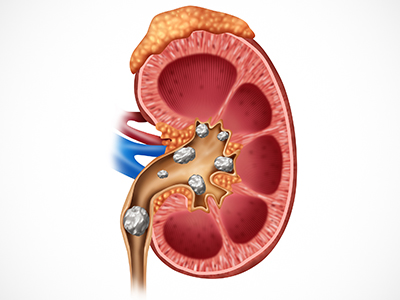
Kidney stones move into the tube that connects the kidney to the bladder, called the ureter, which can lead to renal colic. This can cause severe pain as the stone makes its way out of the body, commonly known as a kidney stone attack. However, it can sometimes be difficult to reach a diagnosis from a patient’s symptoms alone.

Q: Does having kidney stones once put me at higher risk of getting them again?
A:
Previously having kidney stones does increase the risk of developing new stones. It is also possible to have asymptomatic existing stones in the kidney, which may pass out of the body in the future. 

Q: Is drinking more water really the best way to prevent kidney stones? How much is enough?
A:
Increasing fluid intake is an evidence-based way to reduce the chance of forming new stones, which is especially important for people who have previously formed kidney stones. Research has shown that people who have had kidney stones will have a lower chance of forming new stones if their urine output in a typical day is about 2.5 litres. For most people, this corresponds to a fluid intake of about 2.5 litres, or 10-12 glasses of water. Depending on how much someone sweats over the course of a typical day, they may need to drink more fluid than average to achieve the target urine output.

Q: What are the current treatment options for kidney stones? Are there lifestyle changes that I can make to manage them?
A:
If you develop kidney stones, treatment can include medications to reduce the chance of recurrence and interventions to treat or remove the stones. Shockwave lithotripsy is the most common kidney stone treatment. This approach uses non-invasive shock waves to break stones into small pieces for easier passage. Ureteroscopy involves inserting a scope into the urinary tract to remove stones. Another procedure is percutaneous nephrolithotomy, which is when a surgeon removes larger stones through an incision. 

Lifestyle changes are an effective way to manage stones. Some examples of this are making dietary changes and increasing fluid intake, as well as controlling blood sugar levels and maintaining a healthy body weight.

Q: How is research helping to improve the diagnosis, treatment or prevention of kidney stones?
A:
Ongoing research is improving surgical treatment and outcomes for people with kidney stones, and the Vancouver Stone Centre at Vancouver Coastal Health is among the leading centres of innovation in kidney stone treatment and patient care. New approaches and technologies include novel devices that detect pressure within the kidney during kidney stone surgery, Break Wave Lithotripsy technology that treats stones with ultrasonic waves in a minimally invasive approach without need for sedation, and stents that dissolve on their own rather than needing to be removed, among many others.


Dr. Connor Forbes is an assistant professor in urology at Vancouver General Hospital and UBC Hospital. He completed his medical school and urology residency at UBC, followed by a two-year combined clinical and research fellowship in endourology and minimally invasive surgery at Vanderbilt. His research interests include benign prostate hyperplasia and kidney stones.


Researchers

Connor Forbes

Related Articles

Reducing the environmental impact of kidney care in B.C.

Canadians are at high risk of kidney stones: Dietary interventions could help

A gut reaction: The role of microbiome imbalance in kidney stones

Share:

  • Facebook
  • Linkedin
  • Twitter
  • Instagram
  • Email

Related Research Centres/Programs

M. H. Mohseni Institute of Urologic Sciences

Get the latest research headlines in your inbox

Subscribe

Recent News and Stories

Type
Stories

Ask an expert: How can I strike a healthier balance with my daily habits?

Sep 10, 2026 exercise, mobility
Type
Stories

Moving endometrial cancer prevention upstream

Sep 8, 2026 women, cancer, uterine
Type
Stories

Improving respiratory protection for wildland firefighters

Sep 3, 2026 lung, environment, safety
See more news

Get updates!

Join our newsletter mailing list to stay up to date on features and releases.

Subscribe

Quick Links

  • News and Stories
  • Careers
  • Events
  • Media Enquiries

Follow Us

  • LinkedIn
  • Instagram
  • Bluesky
  • YouTube

© 2026 VCHRI. All rights reserved.

  • Contact
  • Privacy Policy