
A health economics analysis of the Falls Prevention Clinic in Vancouver shows how many dollars can be saved by preventing subsequent falls among high-risk patients.
Maintaining physical activity into older adulthood is good for both the body and for the health care system, according to findings of a study led by Vancouver Coastal Health Research Institute researchers Drs. Jennifer Davis and Teresa Liu-Ambrose.
“We know that falls are one of the leading causes of injury among older adults in B.C. and Canada, with approximately one in three adults over the age of 65 falling each year,” states Liu-Ambrose. “We also know that falls can be prevented through innovative approaches to care and by means of integrated falls prevention clinics that are feasible and acceptable to patients.”

Falls can have devastating consequences for individuals. Some serious repercussions are head injuries and hip fractures, as well as lost functionality and independence, which may result in an individual needing to reside in long-term care. Falls also increase the risk of mortality. From 2017 to 2022, deaths due to falls among ages 65 and older rose by 51 per cent in Canada.
“Within the past two decades, the associated costs of falls in Canada has more than doubled and, as our population ages, we expect the health and economic impacts of falls to continue to grow.”

On top of the personal burden to individuals and families, the economic costs of falls among older Canadian adults translates into nearly $7 billion annually, or almost $19 million per day — twice the cost to the health care system for fall-related injuries among individuals aged 25 to 64.
“What is needed at this time, more than ever, is to support our stretched health care system with a refined focus on high-quality evidence to support prevention,” Davis says. “Health economics establishes this evidence to help inform health policy decisions, identifying interventions that can improve health outcomes at reasonable costs to strengthen the sustainability of our public health care system.”
Investing in a falls prevention program paid dividends
Davis and Liu-Ambrose’s study focused on the costs and potential cost-savings of a geriatrician-led falls prevention clinic for older adults compared with health care costs to treat falls among this demographic. Falls here are defined as “unintentionally coming to the ground or some lower level,” which excluded falls caused by a blow, unconsciousness or stroke, for example.
Their study included data from a 12-month clinical trial of 344 community-dwelling older adults over the age of 70 at high-risk of a subsequent fall and who enrolled in the Falls Prevention Clinic at Vancouver General Hospital in 2024. Of these, half of participants randomly received a fall prevention program provided by a geriatrician, with the other half receiving the same fall prevention program plus a home-based strength and balance retraining exercise program delivered by a physical therapist.

Researchers calculated participants’ health resource utilization based on their visits to health or allied health care professionals and hospitals, along with whether participants received procedures and laboratory tests or other investigations in 2024. Costs for these services were based on B.C.’s 2018 Medical Services Plan fee listings, inflated to 2024 Canadian dollars, based on Statistics Canada’s consumer price index.
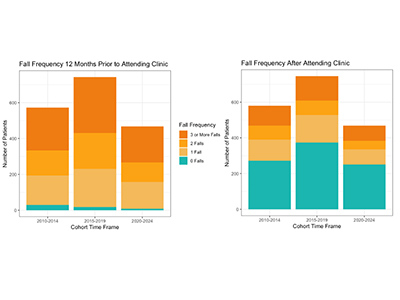
Their calculations determined that the annual operating costs of the Falls Prevention Clinic were around $317,000. Clinic costs directed to 240 new patient visits were close to $51,000, with costs directed to follow-up visits for around 303 patients roughly $37,000, for a total of 543 visits at approximately $88,000.
The research team compared this data to the cost-savings from averting individual falls, which yielded an annual total cost savings of $1.5-$8.5 million, depending on a range of costs per fall. Thus, the Falls Prevention Clinic’s return on investment was somewhere in the range of 500 per cent to 2,700 per cent, with a benefit-cost ratio ranging from 6:1 to 28:1.
“What we found is that, for every $1 invested in the Falls Prevention Clinic, plus physiotherapy-delivered exercise, the health care system would save approximately $2.7,” says Davis.
“On a practical level, this means the program not only pays for itself, but also ends up generating an additional 164 per cent in net savings.”
The program delivery costs, including those associated with adding a physical therapist to the care team, still ultimately contributed to cost-savings from a reduction in falls. Fewer falls translated into fewer trips to the hospital, fewer surgeries and less need for long-term care.
“Falls prevention is a powerful example of how a relatively modest investment to support exercise among seniors can provide meaningful health and economic returns,” states Davis. “Programs like the Falls Prevention Clinic are becoming increasingly important in this current economy.”
“When we think about preventing falls, it is not just about avoiding the injury, it is about supporting people’s maintenance of their independence, their mobility and their quality of life.”
“Like many families, I have seen how a fall can change a person’s life,” Davis shares. “My Nana and Great Aunt both experienced falls that resulted in hip fracture. Both were admitted to the hospital and never returned home. My father also experienced a fall on ice that led to two shoulder surgeries.”
“That fall forever altered my dad’s mobility and quality of life,” Davis continues. “To me, it underscores why preventing falls is so important for individuals, their families, caregivers and communities.”