
Main menu

  • About
    • Leadership
    • Our Team
    • Vision, Mission and Values
    • Health and Economic Impact
    • Strategic Plan
    • News and Stories
    • Careers
  • Research
    • Research Focus
      • Brain Health
      • Cancer
      • Digital Health
      • Healthy Aging and Mobility
      • Heart Health
      • Immune System
      • Injury and Rehabilitation
      • Lung Health
      • Mental Health and Substance Use
      • Other Research Focus Areas
    • Research Centres and Programs
      • BC Centre on Substance Use
      • Centre for Aging SMART
      • Centre for Clinical Epidemiology and Evaluation
      • Centre for Lung Health
      • Dilawri Cardiovascular Institute
      • Djavad Mowafaghian Centre for Brain Health
      • International Collaboration On Repair Discoveries
      • M. H. Mohseni Institute of Urologic Sciences
      • Ovarian Cancer Research Centre
      • Community Research Program
      • Emergency Medicine Research Program
      • Hematology Research Program
      • Skin Research Program
    • Research Cores
      • Clinical Trials Platform
      • VCH-VCHRI AI Hub
      • Indigenous Health Research Unit
    • Researcher Directory
    • Events and Workshops
    • Participate in Research
  • Research Services
    • New to VCHRI
      • Working at VCHRI
      • Regulations and Training
      • Membership with VCHRI
    • Research Development
      • Awards and Funding
      • Research Facilitation
      • Grant Management
      • Learning and Development
    • Contracts and Compliance
      • Contract Facilitation at VCHRI
      • Operational Approval
      • Research Privacy
      • Clinical Trials Administration
    • Research Support
      • Communications and Media Relations
      • Financial Policies and Procedures
      • VCH-VCHRI AI Hub
    • Internal Awards
    • Clinical Research
    • Indigenous Research
  • Clinical Trials
    • Clinical Trials Platform
      • Phase 1 Clinical Trials Research Unit
      • Hematology Research Unit
      • Clinical Research Unit
    • Find a Study
    • Researcher Directory
  • Participate in Research
    • Reasons to Participate
    • Participant Stories
    • Find a Study
    • Recruitment Support

User menu

  • Log in

Breadcrumb

  1. Home
  2. Research
  3. Participate in Research
  4. In the company of robots: Connecting older people at VGH with family

In the company of robots: Connecting older people at VGH with family

Participate in Research Jan 24, 2022 3 minutes

"I say yes to participate in research because I believe it can make life better for my patients and colleagues."

– Jeffrey Dela, Vancouver

As a newly appointed rehabilitation worker with a program for older adults with mental illness at Vancouver General Hospital (VGH), Jeffrey Dela looked forward to leading activities with his patients: going on field trips, watching movies and having tea times. Then the COVID-19 pandemic hit, and the physiotherapist and occupational therapy assistant had to switch gears.

“Patients needed to be isolated in their rooms to protect them from the COVID-19 virus, which was very hard on them and staff,” he recalls. “We needed to find something else to keep patients connected and engaged with the world and recognized the important role that family played in elevating their spirits.”

Around the same time, Dela was contacted by Vancouver Coastal Health Research Institute researcher Dr. Lillian Hung. Hung presented him and the older adult program with her Telepresence Robot Project — run through the Innovation in DEmentia care and Aging (IDEA) Lab founded by Hung.

Dr. Lillian Hung is a registered nurse, an assistant professor with the University of British Columbia School of Nursing and a clinical nurse specialist at Vancouver Coastal Health.

The three-year project is investigating how video conferencing between patients and their loved ones using robots impacts care delivery and the patient experience. 

Family members remotely operate the robots over a secure Wi-Fi connection, moving them around the room on the robots’ rolling stands using integrated hardware and self-driving sensors, which can better accommodate patients with disabilities. 

“The robots give family members a sense of autonomy. They are the driver of the call.” 

The height and tilt of the robot’s screen can also be adjusted to face someone, similar to the animated movements of robots seen in movies. At the end of a call, the robots are programmed to park in an out-of-the-way place and go into sleep mode.
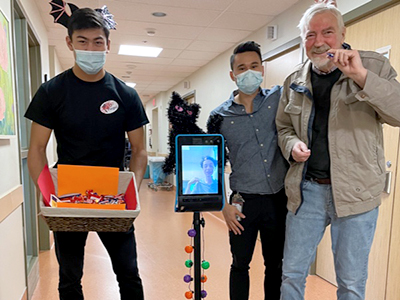
(L-R) Dela delivers Halloween treats to patients with help from a University of British Columbia (UBC) student on the telepresence robot, UBC Kinesiology student Paris Wong and long-term care patient, Doug.

“Especially during COVID-19, when a lot of family members might have been anxiously waiting at home for news, the telepresence robots empower them to regularly see and speak with their loved ones,” says Dela. “This has also benefited the sense of well-being and mental health of our patients.”

See patients talk with their loved ones using the state-of-the-art telepresence robot technology in this IDEA Lab video:

Hung’s patient-oriented research project — which received coverage on Global News and CTV News: Vancouver — is piloting 11 telepresence robots at four Greater Vancouver long-term care facilities. Her research involves patient partners who have lived experience at care facilities, along with care home managers and staff like Dela — who quickly agreed to participate in Hung’s research as a staff partner. 

“The telepresence robots have made my job a lot easier,” notes Dela. “Since there are 20 patients in our program, it is hard to be one-on-one with each patient all the time. So, I just remind a patient that their loved one is going to call on the telepresence robot in 15 minutes and to get ready for the call. Then, when the time comes for the call, the robot rings and the video call starts. The patient doesn’t have to do anything.”

“Because I don’t need to be there to move the robot around the room, I can focus on other tasks and other patients’ needs while the robot is working.” 

“One of our patients was so enthusiastic the first time her daughter called her,” recalls Dela. “She was lying on her bed, and her daughter moved the robot over to her and faced it down so that they could see each other clearly.” 

While Dela is looking forward to a return to pre-pandemic activities with patients under his care, he says the robots are a welcome addition to their team. 

“These are very sophisticated pieces of machinery. And, unlike people, they don’t get sick.”

This is one patient's story of participating in a research study. Your experience may differ. Learn about clinical trials before participating.


Researchers

Lillian Hung

Related Articles

On-hand support while awaiting eating disorder care

Revolutionizing powered wheelchair training for spinal cord injury recovery

Early detection of lung attacks in COPD

Share:

  • Facebook
  • Linkedin
  • Twitter
  • Instagram
  • Email

Get the latest research headlines in your inbox

Subscribe

Recent News and Stories

Type
Stories

Ask an expert: How can I strike a healthier balance with my daily habits?

Sep 10, 2026 exercise, mobility
Type
Stories

Moving endometrial cancer prevention upstream

Sep 8, 2026 women, cancer, uterine
Type
Stories

Improving respiratory protection for wildland firefighters

Sep 3, 2026 lung, environment, safety
See more news

Get updates!

Join our newsletter mailing list to stay up to date on features and releases.

Subscribe

Quick Links

  • News and Stories
  • Careers
  • Events
  • Media Enquiries

Follow Us

  • LinkedIn
  • Instagram
  • Bluesky
  • YouTube

© 2026 VCHRI. All rights reserved.

  • Contact
  • Privacy Policy